
Home
You’re currently viewing our content for All Regions.
You can switch to a different region:
October 15, 2026
For many years, the managed services model has been beyond reproach.
A simple framework built to keep the lights on and close tickets against an SLA. Infrastructure stays up, alerts are monitored, tickets are raised and incidents get resolved – all inside the agreed window, with a monthly report to prove it.
That model has propped up businesses and paid the ecosystem bills for a long time. But in the age of AI, outcomes rule the roost and such mode of engagement is running its course.
“The traditional managed services model was designed for a different era,” outlined Michael Zuppa, CEO of blueAPACHE.
“That model was about keeping infrastructure available and up, monitoring alerts, and resolving incidents against an SLA: those typical managed services deliverables. While that’s still very important and fundamental, it’s just no longer enough.”

Few managed service providers (MSPs) would put it so bluntly, given those deliverables still make up most of what the industry invoices for. But this is not a question of dollars and cents, rather capacity and innovation.
Appointed CEO in July 2025, Zuppa has spent the first 12-15 months rebuilding blueAPACHE around a different idea of what an MSP is for. Whether customer value, technology updates or vendor partnerships – none were in isolation and all form key pieces of one strategic puzzle.
“All of that is coming together into a much broader strategy,” Zuppa explained.
“I tie it back to our core vision. At blueAPACHE, we want to be the global mid-market IT service provider of choice. To deliver that, we have a mission which we’ve evolved: empowering our clients to outpace change, turning secure, reliable access into a launchpad for automation, transformation and long-term resilience.”
The phrase that keeps coming back in conversation with Zuppa is a simple one.
An MSP of the present and future will be measured not by how many tickets it closes but by what changes for the business it serves.
That means a shift from being a set of tools and response times to becoming a platform that a customer runs on, one that keeps improving and frees people to work on the things that actually move the dial.
“A modern MSP should be providing more of a governed operational platform that continuously improves security, experience, automation and visibility, so that the customer’s internal IT capacity, and that of our service delivery management, can move up the stack,” Zuppa outlined.
“Then we can be talking about key business process mapping, productivity enhancements, operational efficiency gains, the use of AI and changing the way we work.
“It’s that shift from tickets to outcomes, from reactive response to predictive intervention, which is what we’re doing with all the tooling integrations. And from isolated tools and disparate technology sets to a more orchestrated operating model.”
Talk of automation inside a services business usually ends in a question about headcount. But Zuppa was quick to clarify.
“The people don’t disappear,” he continued.
“The routine work becomes more automated, the tooling becomes far smarter and agentic in its own nature, and the effort moves towards judgement, design, governance and those higher-value outcome services.”
But if the case for change is that clear, why isn’t the market already there? Zuppa is candid that blueAPACHE is doing as much pushing as being pulled.
“A little bit of both, because customers are at very different places in their journey,” he observed.
“But it’s based on making sure we can deliver on that mission. If we’re going to help our customers outpace change, we need to drive this to them.”
The bigger part of the answer is where those customers sit.
The mid-market is caught in an awkward middle. Smaller businesses can rip out and replace systems with little ceremony, and large enterprises have the money and the specialist teams to buy their way past a problem.
Mid-sized organisations get the complexity of the second group with something closer to the resources of the first.
Zuppa understands the position well, because blueAPACHE is in it too.
“We support the mid-market, and the mid-market is in a very, very tough position,” he continued.
“We ourselves are a mid-market organisation if you look at scale and turnover, so in a way we face the same challenges. But we’re lucky, because we’re technologists.
“In the mid-market, you have the complexities, regulations and demands you would in the enterprise. You have some legacy and some restrictions, so you can’t move as quickly. So it’s not so much a challenge of innovation. We see it as a challenge of capacity.”
That reframing matters, because it changes what the MSP is meant to fix.
If the problem is a shortage of ideas, the answer is more advice. If the problem is that every hour of internal IT time is already spoken for, the answer is to give those hours back.
For Zuppa, that starts with simplifying and standardising, and with getting customers off the patchwork of disconnected tools that eats so much of their time.
“What’s taking up the capacity?” he asked.
“That’s where we need to help customers simplify and standardise, to stop using disparate tooling and start using tooling that is integrated, because all of this is getting smarter and AI is getting embedded into it.”
On AI, the questions are endless:
“We’re also openly saying that over the next two to four years we expect managed services pricing to come down significantly, but only for customers that have adopted the aligned delivery technology behind it,” Zuppa added. “With an orchestrated platform approach, you can really drive down the costs.”
Zuppa’s picture of where the market ends up is concrete. The service desk as most staff know it – a phone number or a portal and a queue – gives way to an agent that answers, diagnoses and in many cases fixes the problem before a person notices it.
“We paint a picture where, if a customer wanted to, they could inevitably have a fully agentic AI-driven service desk,” Zuppa detailed.
In this scenarios, calls can be answered by an AI agent with access to knowledge, prompting the next questions, raising a service request and solving a ticket. The shift to autonomous desktop is already under way with many issues getting fixed without the customer even knowing – meaning they won’t have to raise a ticket anymore.
“Interaction will just be with an agent,” Zuppa shared.
“Maybe in their Teams chat: ‘I need a service request, I have an issue, I have X.’ The agent will dictate the response based on the next best course of action. This is coming fairly quickly.”
But none of that works without the basics in place, and the basics are getting harder.
Vulnerabilities are multiplying across endpoints and devices, and the only realistic answer is technology that can be managed, patched and watched centrally.
But Zuppa’s point is that the foundation an MSP is responsible for no longer stops at the laptop and the server room. It now runs all the way up into how a business builds and governs its AI.
“It’s about the message: get the foundations right,” he advised.
“And the foundation layer we bring to our customers now goes beyond the endpoint and infrastructure your traditional MSP would be supporting.
“That same foundation now needs to lift up. Where are you storing, creating, administering and governing your AI workloads and ecosystems? All the same fundamentals apply there: governance, regulation, who’s got access, visibility, identity.”
Consequently, Zuppa’s advice to customers trying to keep up with a new model release every few weeks is to stop trying.
“Don’t choose models, choose a platform,” he explained.
“The platform is the thing that will be more stable. Call it the plumbing you put into the business. You don’t want to be changing that out all the time, whereas models are changing frequently. So it’s making sure your data, AI and governance are put in correctly, monitored and visible. As an MSP, that’s the next operating layer we’re responsible for managing.”
The clearest illustration of the difference between the old managed services model and the new one is that around 55% of end-users avoid raising tickets at all.
“That actually seems low if you think about it,” Zuppa challenged.
“How many people have a Teams call that wasn’t great and then go and raise a ticket afterwards? They just carry on. This is what they call the silent sufferer, and that’s huge in terms of productivity and operational efficiency.”
There are two problems hiding in that number: the fault itself, and the effort of reporting it.
“It’s just friction,” Zuppa summarised.
And the cost is not only technical. Staff who quietly put up with tools that don’t work are staff who are quietly frustrated, which makes this as much a question for a Chief People Officer as for a CIO.
A model that measures success by closed tickets can’t see any of it, because the ticket was never raised.
Which is why blueAPACHE has stopped waiting for one.
“For us it’s about not relying on people to raise tickets, and instead measuring the experience of their device against every other device in the environment, and every customer against the other customers we have,” Zuppa shared.
“What’s the experience based on device models, geolocations, network connections? You take all that rich telemetry and start putting predictive, proactive and even automated remediation on top of it. It surfaces things in a very different light in how we drive operational efficiency.”
What gets measured has changed with it. Whether a device is up offers very little about whether the person using it can get their work done, and that second question is the one blueAPACHE now reports against.
“It’s no longer about measuring tickets and SLAs, but measuring outcomes and experience,” Zuppa continued.
“That’s a big change in the managed services model we’re launching. It’s all about outcome-led, measured results. We’re measuring real-time user experience.”
The same thinking extends to a part of the stack most mid-market businesses haven’t yet looked at closely: the running cost of their own automation.
An agent built to take friction out of a process might pay for itself in its first month and quietly stop doing so a few months later, and in most organisations nobody would notice.
Zuppa sees financial operations as the next layer an MSP has to manage, and remains honest that the market is still maturing.
“Not everything is available today,” he acknowledged. “It’s about having the foundation and platforms in place to support where this is evolving.”
Through FinOps, businesses are seeking to measure the outcome of the identified use cases that automation or agentic action is placed against. It might be viable today, but is it still viable in six months’ time?
“Businesses create it and forget about it,” Zuppa expanded. “They’re not really looking at it, and they’re not sure how much it’s using.
“So, it’s about economic outcome measurement. What do I have? Where is it running? What was it intended to save me? Is it still saving me that? Even if it is, is there a more efficient way of running it now than six months ago?”
Understanding and assessing the economics of running such agentic workflows becomes critical because while organisations might initially run projects using agentic AI, once a process has been established, perhaps that can instead by ran as standard workflow automation in logic.
“Businesses don’t always need to be drawing down on tokens, costs and expenses,” Zuppa advised.
For all the talk of platforms and telemetry, Zuppa is firm that the hardest part of this shift hasn’t been technical. It is the organisation itself, and the willingness of the people at the top to change how it works.
blueAPACHE has been through that before.
When the push came for Essential Eight and ISO 27001, the business went first, made itself the test case, and then turned what it learned into something customers could use.
“This is not a technology problem,” Zuppa clarified.
“It’s an organisational challenge, a cultural challenge and a new way of working. What we’re doing is essentially being customer zero, the same way we did with the whole wave of Essential Eight and ISO 27001.
“Do it all ourselves, go through the certifications, get the training, the processes and the enablement, then codify it into a blueprint that can be reused for our customers. That’s what we did then, and we’re doing it again now. It’s just that this time it’s moving at such a fast pace.”
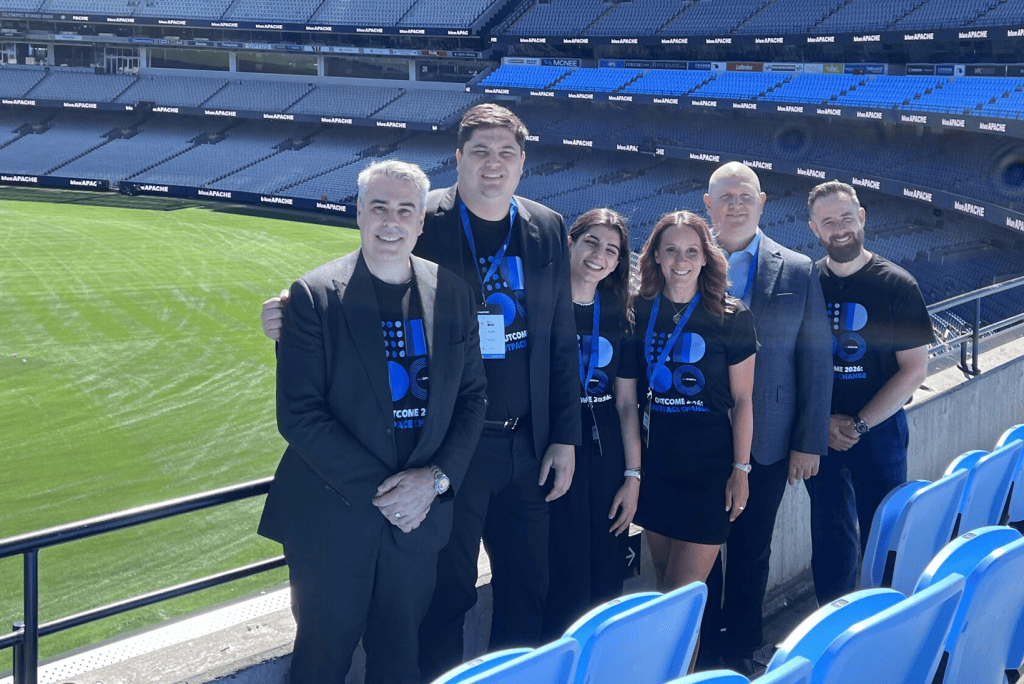
For example, businesses attempting to achieve a security standard without executive endorsement and buy-in from the top will never succeed.
“They won’t get certified,” Zuppa stated.
“It will never happen, because it’s a cultural, top-down driven initiative. This is even more so. It requires an organisational shift and a move towards a new way of thinking and working. That’s why we say it’s not a technology problem. The technology is there.”
Being customer zero this time meant asking an uncomfortable question about blueAPACHE’s own future. If tickets stop being the unit of work, what happens to a business that has always been organised around them?
“It’s still ongoing and yes, it’s a journey,” Zuppa acknowledged.
“The same construct we’re advising customers on, a standard framework approach, is what we’ve taken ourselves through. We had to look in the mirror and reflect: what is it that my business does, and how is it going to look in three to five years’ time?
“Are we going to be disrupted? Are we going to disrupt? What will the expectation be? What happens to that MSP-type service if you don’t even need to raise tickets? What does that mean for a help desk?”
Zuppa and the team’s conclusion is that the work doesn’t disappear, it changes shape. Running fleets of agents, workflows and platforms is complex in its own right, and that complexity is where the next generation of managed services sits.
“A lot of that isn’t going away,” he continued.
“It will be dealt with in a different capacity and probably shift up, but it will be more about orchestrating and managing these platforms and agentic flows, because that is a lot of complexity in itself.”
This is where Zuppa’s earlier prediction on falling prices comes back with its reasoning attached.
Strip out much of the cost of traditional management and the money can be redirected, which customers will need, because nobody’s budget is growing to fund the old world and the new at once.
“Customers will benefit from the massive efficiencies that come through experience-led, autonomous endpoint and autonomous network-driven solutions,” Zuppa explained.
“The benefit is that managed services costs will come down significantly on what would have been traditional management, so they can shift that spend to more meaningful, consultative, engagement-led services that manage and monitor agentic users, workflows, platforms and experiences.
“Otherwise they’ll still have the old spend, they’ll still need to do the new, and their budgets aren’t going to be increasing.”
Inside the business, that reflection turned into a rebuild.
Zuppa didn’t start from the stack blueAPACHE already had and look for gaps. Instead, the team started from a blank page and asked what a provider would need if it were launching today with the aim of reshaping the category.
“It was a full review,” Zuppa shared.
“You start with a fresh piece of paper and ask: what do three to five years look like? If we were starting today as an MSP to really disrupt and define the market, what would be needed? Based on where things are going, who do we think is going to keep the pace?”
Nothing was protected, including decisions the business had made and paid for only recently.
“You start right in the heart and lungs of everything, which is the ITSM,” Zuppa continued.
“We made some significant investments a few years ago, which we questioned. And it’s a good thing to question, because nothing should be off the table when things are moving this fast.”
From there the review worked outward: how customers interact with the service and how those interactions feed into the system, then device management, which carries the weight of patching and vulnerability scanning.
The biggest addition was a layer that didn’t exist in the old stack at all.
“The new one we incorporated, because it wasn’t there before, is digital end-user experience,” Zuppa added. “That’s a whole new layer we brought into the stack.”
Key vendor partnerships include a long-standing alliance with Hewlett Packard Enterprise (HPE), in addition to ControlUp, Huntress, Mimecast, NinjaOne and Zoom among others.
Some layers are still under watch. Observability and FinOps are moving quickly, and Zuppa is content to let the market settle before making a final call.
The larger commitment is to Microsoft. blueAPACHE is adopting Fabric and Foundry across its own operations, partly to pull data and intelligence from every tool into one place, and partly because these are the environments it will soon be managing for customers.
“The bigger part for us is the full adoption of the Microsoft ecosystem ourselves, in terms of the Fabric layer and Foundry,” Zuppa said.
“How do we bring all the data, connections and intelligence from these platform tools into a new, modernised reporting function that someone can interface with?
“We also need to build more intelligent ways to connect to all of these systems, using MCP servers and the like. And for the custom agents we build ourselves: where do we build them, where do we monitor them?
“So, we’ve incorporated the Microsoft Foundry ecosystem into our services to show what’s possible, because that’s what we’ll be monitoring and managing in customers’ environments as well.”
A rebuilt stack only differentiates a provider if customers can buy it in a way that fits them, however.
blueAPACHE serves some smaller businesses, mostly the mid-market, and a growing number of organisations on the line between mid-market and enterprise, and those customers want very different things.
Hence the need to package the platform in different ways:
The first is the familiar one: the customer that wants the outcome and the help to get there, and takes the full managed service.
The second is where the rebuild pays off most visibly, however. Organisations that have brought IT in-house don’t have to choose between their own team and an outsourced provider.
“We’ve literally changed every single component in our service stack,” Zuppa showcased.
“We’ve put it together as an integrated platform, which lets us go to an organisation running internal IT ops and say: keep your people, just adopt this platform. It’s already integrated from endpoint through to data centre, FinOps and observability, and you’ll get these efficiencies.
“The time to value, compared with trying to stitch these things together yourself, is substantial. Most of our customers are Microsoft-centric, so it just makes so much sense. We’re building across those layers to support that for them. So that’s platform-as-a-service.”
The third is the enterprise, where blueAPACHE works as a delivery partner for the vendors that sit underneath its own platform.
“Think of us as an integrator,” Zuppa explained.
“A customer can deploy into their own ecosystem, take a platform, or take a full outcome-managed service experience. That’s how we’ve productised it all now.”
Changing what customers consume means changing how they think about buying, and that takes education.
Plenty of education, to be precise. This is more about showing businesses what they can do, and where attention should now be spent.
Zuppa’s way of explaining it is a car.
Too many organisations spend limited capacity comparing vehicles when they already have a way to get where they’re going. The time is better spent on the journey itself.
“If I need to get from A to B, am I driving a Toyota or a Ford?” Zuppa questioned.
“How much time do you want to spend assessing and working out which car gets you from A to B? You’re already getting from A to B. Now let’s look at how your business does what it does.
“Spend that capacity, that innovation capacity, on your business. Think about your business processes and flows. What’s the low-hanging fruit? Where can we take a little bit of friction out of each process? Don’t try to go too big. Just show how much is already possible using simple agents and Copilot Studio, without even getting into the Foundry side of things.”
Because the change is cultural, blueAPACHE helps customers grow their own champions through training partners, so that the people inside the business learn to find and back good use cases themselves.
Zuppa is just as frank that his own team is learning alongside them.
“It is an educational thing, because we teach them, but we’re also teaching ourselves,” he shared.
“One thing we say is that we are not the experts in everything. We do not know everything. We’re probably a couple of months ahead of our customers, the more progressive ones, because it’s moving at such a fast pace. That’s why it’s super important to partner well, because we can’t know everything.”
That is where blueAPACHE’s relationships with Microsoft and SoftwareONE also comes in, bringing in specialist AI expertise across industries when a customer needs more than the foundational work. It also brings Zuppa back to where the conversation about procurement started.
“We have to help them unlock that capacity,” he clarified.
“The only way to unlock it is to change the way they think and the way they procure solutions. Don’t choose a Ford or a Toyota. Choose the outcome.”
Zuppa’s sharpest warning reaches well beyond blueAPACHE’s own customers because he has watched a cycle like this before.
As cyber security insurance and standards took hold, suppliers were buried in questionnaires about how they handled data, until certifications gave everyone a quicker way to tick the boxes.
In a similar vein, he expects AI to start that cycle again – and to hit harder.
“I see this next wave coming, and it’s going to hit us hard, because of the trust element around AI usage,” he explained.
Businesses are going to ask:
“Right now, you could ask me about one of my suppliers: Are you using AI?” Zuppa continued.
“Yes, you are. Can you tell me about it? Of the information you use to service me as a customer, what is it touching? How do you prove it? How do you show it?
“All of this regulation is going to hit customers very hard, because they can now develop software pretty easily and pretty quickly. But where’s the security control and governance around it? How do they know it’s safe? How do they know how it’s actually being used?”
This is the practical case for everything Zuppa has articulated about platforms.
A business that builds, governs and monitors its AI in one place can answer those questions. One where agents have sprung up wherever someone found them handy will be left scrambling for the answers.
“It’s an interesting wave coming,” Zuppa assessed.
“We know our positioning is already resonating. We’re already winning new contracts into the re-engineered managed services. So for us, it’s getting our customer base aligned and transitioned into these new service models, and getting more enablement and more AI workflow engagements happening.”
Inform your opinion with executive guidance, in-depth analysis and business commentary.

