
Home
You’re currently viewing our content for All Regions.
You can switch to a different region:
July 30, 2025
20 minutes into the conversation, Brenton Johnson looked up above his monitor – presumably organising his thoughts as the questions became more pointed and probing.
At this point in the interview, focus shifted to Tony Hsieh – author of Delivering Happiness who passed away in 2020 – and how he hated his old company culture. They screwed it up, he never wanted to go to work, so he started from scratch.
With an estimated personal wealth of $840 million, the CEO of Zappos didn’t need the money. But he didn’t want to work in a bad environment so he created core values that were both distinct and clear.
“We’re kind of the same,” added Brenton, in reference to Uptake Digital, the managed service provider (MSP) he founded in 2014.
“We’re not out to make a gazillion bucks and we don’t want to be the biggest MSP of all time. We just want to sit at that top-tier of bespoke providers that customers rave about and have a fun place to work alongside.
“Going from a 9 to a 10 is so much harder than moving from a 5 to a 9.”

There’s an absence of ego in that statement however. Rather a quiet confidence that nuggets of gold can be extracted from extreme places, mixed together and used as foundations for company culture and ethos.
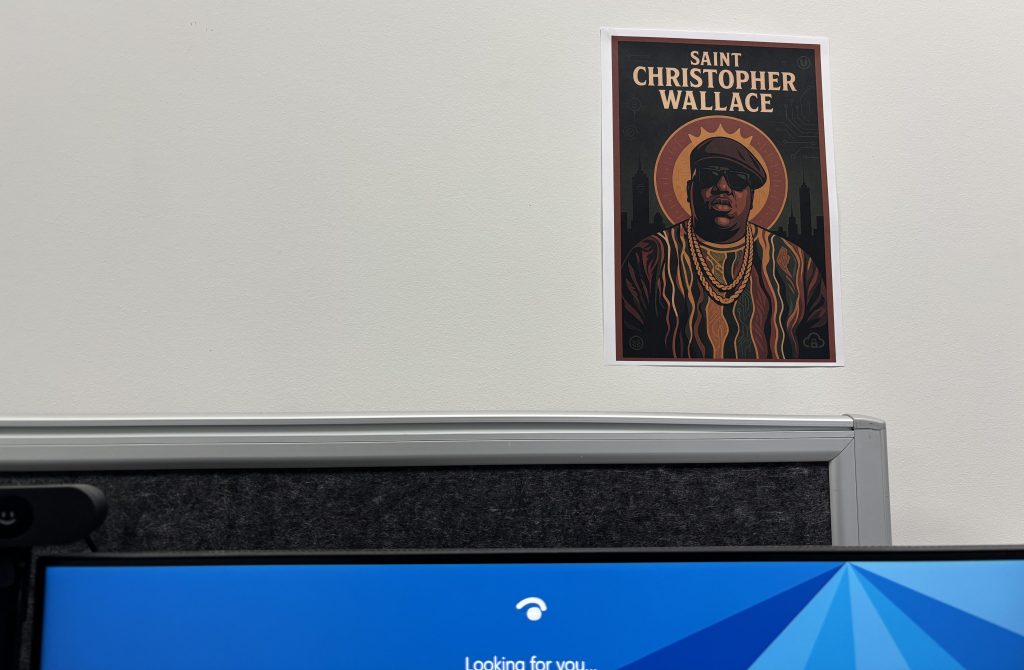
“You know, I’ve got an AI-generated picture of Biggie Smalls hanging over my desk,” shared Brenton, eyes looking skyward.
“Sometimes when I don’t know what the hell to do next, I look up and ask… ‘what would Biggie do?’ Seriously. I get the team in, we all sit around and he becomes the other person in the room. You know? Ah, I don’t know.”
Delivered with a grin but laced in gospel truth, Brenton expanded.
“Everyone has the same core values, they all plaster words like ‘integrity’ in large font on their websites,” he observed. “You know the usual, ‘we always do the right thing’ – what does that even mean? And who even cares?”
In fairness, the industry does often lack depth or personality. Tokenisation that should be table-stakes is repeatedly held up as ground-breaking gestures that go above-and-beyond.
Integrity. Trust. Dependability. Well, yeah, of course.
“Everyone knows what the culture is where they work but it’s very hard to articulate in an authentic way that isn’t those cliched words,” Brenton added.
When writing the core company values of Uptake, Brenton experimented with ChatGPT and arrived at a conclusion that was not only unique, but bang on the bullseye.
“It’s a mix of the golden age of hip-hop – so 1985-1995 – with good old fashioned country values from regional Victoria,” Brenton stated.
At a high-level, that can be broken down as the authenticity of hip-hop in its heyday combined with the community spirit of small towns in rural Australia.
“Culture is a really big thing,” Brenton acknowledged.
“If you get your culture right then everything else becomes easier by comparison. But if you have a terrible culture then you’re basically on a sinking ship.”
Straight outta on-prem, still slinging SaaS
The origin story of Uptake is anchored in the Web 2.0 era. Website demand was ferocious as businesses moved away from “crappy brochure websites” in favour of a modernised online presence.
Bendigo was the birthplace, 150km north-west of Melbourne.
Upon interacting with customers, Brenton realised the most common challenges actually centred around IT and legacy on-premises infrastructure. This prompted a shift into emerging technologies such as Microsoft Office 365 and Dropbox, which were underrepresented in a market crammed with box sellers.
“Businesses were getting sold websites that looked fancy but solved nothing,” he recalled. “Their IT was broken – clunky, outdated, stuck in box-reseller land.
“But no one was offering them the modern stuff because they didn’t know how to do it. There was no channel. No blueprint. Just resellers flogging tin and calling it innovation.”
After a quick-fire decision to align with Microsoft over Google, Brenton rode the early cloud wave to take a commanding lead in the market.
Despite being a fledgling MSP, the business completed more than 50 Microsoft Office 365 migrations before Cloud Service Provider (CSP) status even existed. That was no easy feat in an ecosystem still changing over from BPOS at the time.
Induction into the newly formed Microsoft CSP program soon followed, supercharged by a local partnership with Rhipe – a cloud distributor acquired by Crayon for $408 million in 2021.
“We started early but we didn’t know what we were doing,” Brenton shared.
“We just followed what Microsoft told us to do but it meant that we were always a product ahead of the market. While everyone else was still getting their heads around Cloud Hosted Exchange, we were in the weeds with Intune.
“Then we had to learn managed services and understand how to build that.”
Partly driven by “youthful arrogance”, Brenton was bullish that “everyone else was stuck in the past, and I could do it better.”
There was an assumption that everything was simple, whether selling software-as-a-service (SaaS) or scaling an MSP.
Solve Problems. Get Paid. Eat. Sleep. Repeat.
“Turns out it was a little more complicated than that,” Brenton laughed.
“Success to me still means best-in-class customer outcomes for happy customers but now I also consider the success of my team and the success of the industry as a whole. I see success as a verb rather than destination.”
For Brenton, the early days of Uptake chime with the late 1980s and early 1990s of hip-hop.
Biggie Smalls – also known as ‘The Notorious B.I.G.’ – was a revered hip-hop artist and face of East Coast gangsta rap. He was shot and killed on March 9, 1997. Often labelled as the “voice that influenced a generation”, Biggie is one of the most emulated and biggest-selling rappers in the game.
“I love the authenticity of hip-hop,” Brenton added. “It was a time when everyone had to stick together and it was a dangerous place.
“The music was real and it was all of that, very authentic and lives on today. It will live on for hundreds of years because it comes from this group of scrappy people on the street with tape decks, just trying things and making music. It’s very entrepreneurial.”
Without having a corporate career as guidance, Brenton found the grit to be tougher and the grind to be harder in his own life.
“A lot of all that was quite challenging, especially the politics,” he admitted. “At the start, I would go to a customer with a very obvious solution to a problem but they wouldn’t buy it, they would buy this other thing that would make no sense.
“There were a lot of home truths to deal with.”
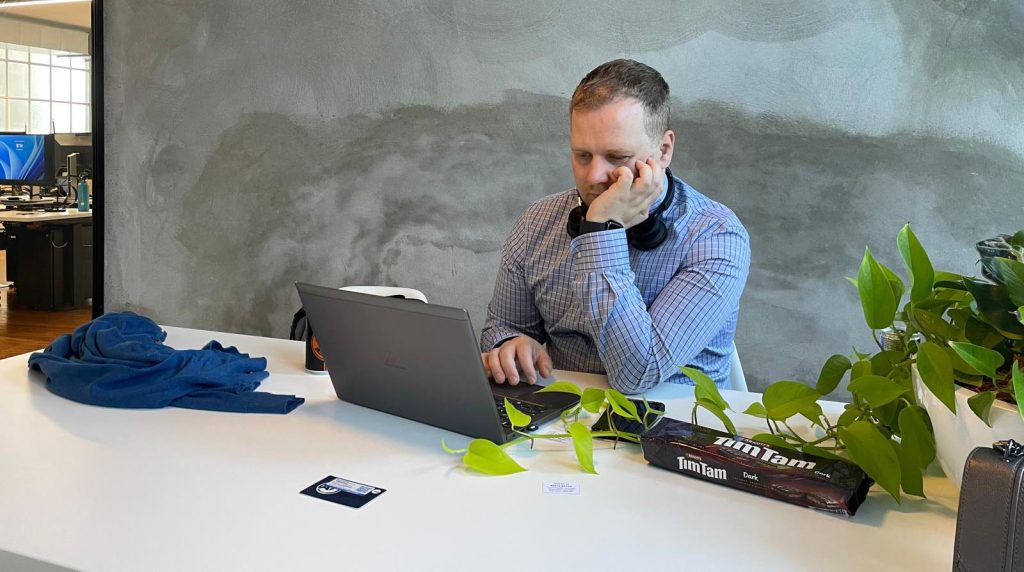
It took time but Brenton came to understand that organisations can only focus on two or three things at any given time. And while solving a particular problem might be the number one thing in your world, the MSP seldom sees the bigger picture.
“You can build a relationship but you’ll never know that extra slice of information,” he said.
“I learned to go over to the customer side and realise, perhaps their boss doesn’t care about this, maybe they have a bottom line issue, perhaps they are going through a marriage break-up.”
Whatever the roadblock, acknowledging that an invisible dynamic is always at play came with age and experience for the one-time overly logical entrepreneur.
Brenton – who was the youngest Rotarian in the district at age 21 – also cited the role of his parents in shaping his personal and professional approach. Working at McDonalds was also a “really influential” early experience.
“I’m very technically capable in that I can pick something up, learn it and do it,” Brenton added.
“But I had to put the effort in and really learn how to talk to customers, do sales and communicate properly. Even understanding the differences between organisations, the nuances and playing the politics.”
Country values, community spirit
Born in Ballarat before living in Tasmania – Midway Point area – Brenton moved back to Victoria and started the business in Bendigo.
As a country boy through and through, the move to the bright lights of the big city in Melbourne came only six months ago.
“I like it,” he assessed. “The business started in Bendigo but all of our customers are in Melbourne, plus we had the challenge of finding innovative people with stable Internet connections. So it was an obvious move.”
While you can take the boy out of Bendigo, you can’t take Bendigo out of the boy however.
“How can I best explain it?” Brenton asked. “It’s like we’re all on a boat together because growing up in a country town, everyone would do so much work to keep the town running.
“My father would be the treasurer of the footy club, your father would be the secretary of the RSL and so on. That’s the community element and for those we hire from the city, we explain those values to them.”
As Brenton put it, the team is compromised of country folk, including one who grew up in Indonesia but lived in Bendigo, plus a guy from Adelaide “given that’s like a big country town”.
“They all instinctively understand community,” he continued. “It’s such an important cultural element of what we do here and we think of the MSP as doing a good job for the community.
“To be honest, it’s a work of love because you don’t do it for the money. You have a problem? We’ll come out and spend half a day showing you how we fixed that problem. That’s so common in MSP and one of the aspects I like most about the entire industry.”
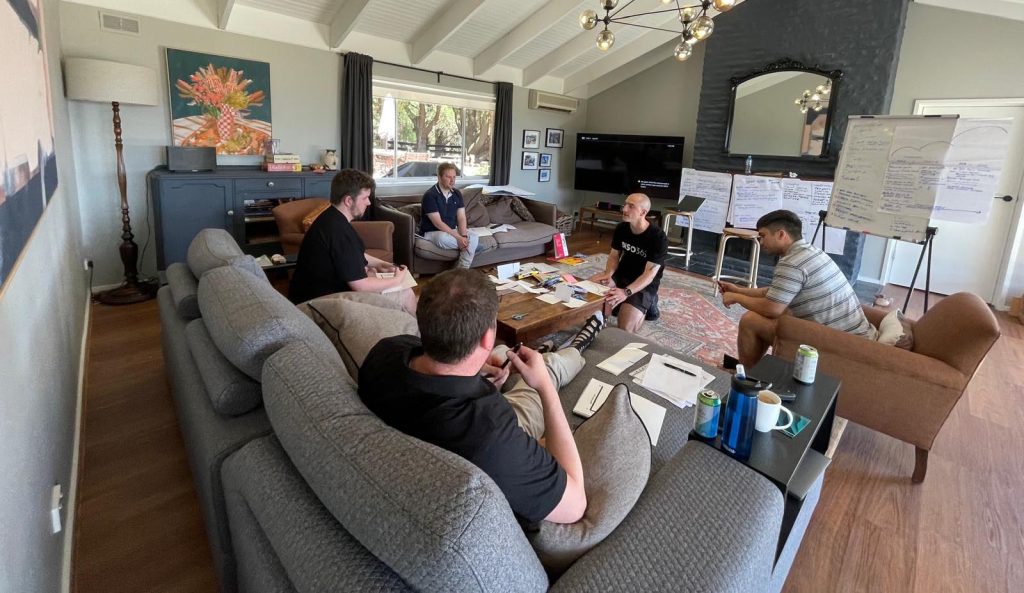
From a customer perspective, Uptake is vertical focused and fiercely selective.
The primary user base consists of not-for-profit professional services organisations with a focus on health and member associations – “they just get us.”
“Money is like oxygen, it’s not our primary motivation unless we are running out of it,” Brenton stated.
“But we turn down more work than we accept. We’re not the biggest MSP and we don’t want to be. We’re not chasing logos or revenue-for-the-sake-of-it. We care more about fit than volume. We’ll walk away from the wrong client, even if it costs us.”
In describing Uptake as a “collection of brilliant technologists with the warmth of a home cooked meal,” Brenton is big on strength-based roles.
For example, hiring five Brentons will guarantee that nothing gets done, aside from hanging out with the customer and having a good time.
“You don’t need five account managers or five entrepreneurs,” he clarified.
“I made every mistake I could make when building a team which is why feedback is everything. You don’t learn just from failing. You learn from failing and hearing what you did wrong.
“I’m not a genius entrepreneur. Most of what I’ve built came from asking people for help, listening and doing what they told me to do.”
Armed with the authenticity of hip-hop and the spirit of community, Brenton is aligned to the belief that new entrepreneurs must “look for the blue oceans” and carve out market breathing space in which to operate.
In other words, avoid competing head-on with established and incumbent players.
“Don’t do things that someone else has been doing for 20 years and they are world class at it,” he recommended. “Go and find the other thing that they should be doing but they’re not and do that instead.”
It’s common for Brenton to be quizzed on the merits of starting a new MSP and his advice is always returned with a caveat.
“Have a think about what you want to manage,” he advised. “There’s a lot of mature MSPs and it’s a difficult offering to get right which could take 5-10 years to spin up properly.
“So perhaps compete with them in the AI space instead. You’ll probably beat them because you’re new, you’re nimble, you’ve got the energy, you’ve got the effort and what do they have? A big ship to turn.”
And if you’re still out of options you could always ask… ‘what would Biggie do?’
Inform your opinion with executive guidance, in-depth analysis and business commentary.

