
Home
You’re currently viewing our content for All Regions.
You can switch to a different region:
October 7, 2025
Competitive advantage no longer comes from budgets or size – it comes from how fast businesses can mobilise a new kind of workforce.
Like every other organisation, Fusion5’s first encounter with AI came with a dose of dazzlement. The potential was huge but so were the unknowns. We were testing, exploring and trying to work out what was real and what was noise.
That phase is behind us. What’s clear now is that the winners won’t be the ones who dabble.
They’ll be the businesses that can mobilise human and digital teams quickly to unlock productivity, personal growth and financial performance.
“This isn’t about adopting AI tools,” said Shannon Moir, Director of AI at Fusion5. “It’s about redesigning the workforce for the next decade, and AI just happens to be the catalyst.”

Transformation, not tinkering
At Gartner IT Symposium/Xpo 2025 on the Gold Coast, the message was clear: transformation is the point, not AI itself. Vendors pitching AI as the destination are already behind.
The reality is that transformation has always been hard to get right. Few organisations fully realise the value they expect and AI doesn’t make it any simpler. In fact, it adds more layers. This shift touches almost every role and every process, which is why it feels daunting. Because it is.
Those layers run right through the business: from new technology, to human reaction and response, to the need to reskill at every level, to risk, data and security. And the list doesn’t end there.
“We realised early that there’s a lot at play here,” added Troy Gerber, CTO at Fusion5. “You need momentum but you also can’t afford to sprint blindly. It’s about moving fast enough to build confidence, without going so fast you lose trust.”
What it looks like in practice
Transformation sounds big, but what does it look like on the ground?
At Fusion5, we started with ourselves, testing, trialling and proving agentic AI solutions inside our own business before taking that knowledge to clients. One of the clearest examples is in our legal team.
Facing unrelenting contract volumes, they introduced a digital colleague, Agent Claire. Claire handles first-pass reviews, highlighting risks in a colour-coded “doughnut” report. Contract reviews that once took hours now take minutes, with overall time savings of up to 70%.
But the real shift wasn’t just speed. It was perception. Legal went from being seen as cautious and conventional to recognised as early adopters. That kind of cultural shift has knock-on effects across the whole organisation.
“When a function like legal shows it can lead with AI, it sparks lightbulb moments everywhere else,” Moir explained. “That’s transformation, when people stop asking if AI can help and start asking where it should help next.”
Human judgment stands out more, not less
There is a lot of commentary about AI replacing jobs and our own people felt some of that anxiety at the start. What we have seen in practice is the opposite. Working alongside agents has reduced that anxiety, because teams can see the boundaries of AI, what it can and what it cannot do.
What stands out even more is the value of human judgment. When an agent handles the repeatable work, it throws the spotlight on the things only people can do: spotting nuance, reading between the lines and bringing context. That has been reassuring, and it has reinforced the importance of human experience in a blended workforce.
“We now have digital employees on our organisation chart and that changes the role of a leader,” Gerber shared. “It is no longer just about managing human capability. Leaders have to manage human and digital capability together, and that is a very different kind of responsibility.”
The leadership imperatives
Claire’s story highlights some universal lessons for leaders:
“Technology alone doesn’t deliver transformation,” Gerber said. “Success comes from blending AI with process expertise and cultural change. That’s what creates durable advantage.”
Why this matters now
Most organisations have started experimenting with AI in some capacity. But few have moved beyond individual tools or platform features into agentic AI solutions, where digital colleagues can take on tasks, learn, and work alongside people.
McKinsey reports that fewer than 10% of AI use cases ever make it past the pilot stage, which shows just how hard it still is to move from experimentation to scaled impact. That gap means the competitive advantage is still wide open, particularly over the next 12 to 24 months.
“You don’t need perfect conditions to start,” Moir advised. “Customers are already seeing 20 to 30% productivity gains across different business functions. This isn’t theory, and waiting will not get you closer to the future you need to build.”
Where to go from here
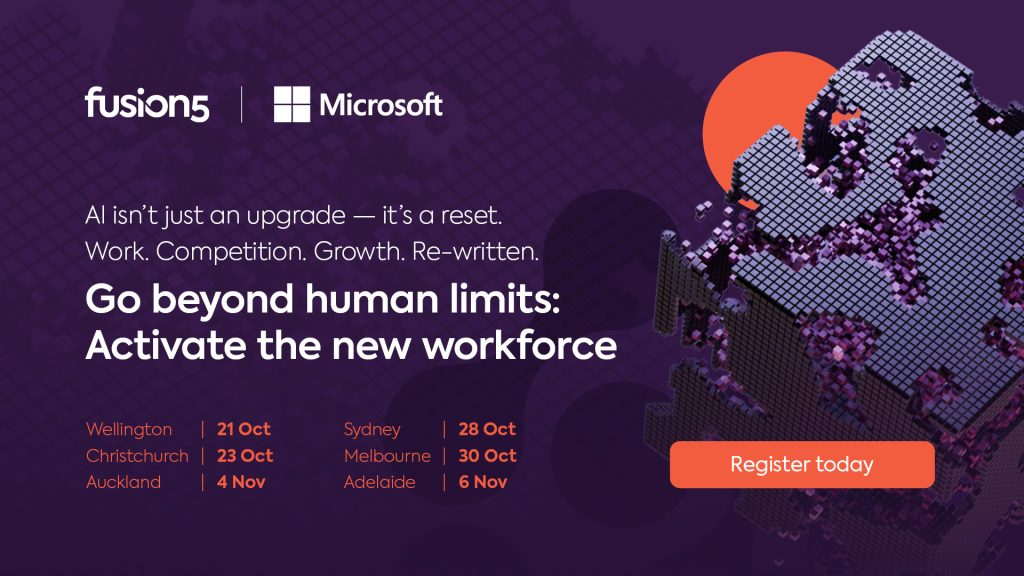
That’s exactly the focus of Going Beyond Human Limits. A no-cost, half-day event series across eight cities in Australia and New Zealand. Designed for business and technology leaders, the sessions get beyond the hype and show how agentic AI can drive workforce transformation today.
You’ll hear case studies from across industries, understand the steps to safely introduce agents, and leave with a practical playbook for blending human and digital teams in your own business. Just as importantly, you’ll connect with peers facing the same challenges and opportunities.
Register here to secure your place:
Inform your opinion with executive guidance, in-depth analysis and business commentary.

