
Home
You’re currently viewing our content for All Regions.
You can switch to a different region:
October 28, 2026
Market volatility has a way of exposing the difference between organisations that operate efficiently and those capable of responding competitively.
For years, technology investment has focused on improving productivity, automating processes and reducing operational costs. Those priorities remain important, but they don’t necessarily translate into competitive advantage when market conditions change.
Romit Raut – CIO at WORMS Safety in Hong Kong – believes the distinction comes down to how quickly organisations respond.
“When we look at the operations or to operate, it’s basically about efficiency,” he said. “But in the volatile market, the challenges are not efficiency at all. It’s about how soon you can adapt your decision.”
When opportunities emerge, decisions that previously took months may need to happen within weeks. Organisations unable to adjust risk losing business before they can respond.
“Technology is the only way to get faster visibility, shorten the cycle, and allow teams to work faster without having multiple layers of approval,” Raut added. “Efficiency keeps you running, but the responsiveness helps you to win.”
For boards, the challenge is determining which investments genuinely improve an organisation’s ability to compete, rather than simply making existing operations more efficient.
To watch the full episode of When Markets Move, Strategy Matters – click here.
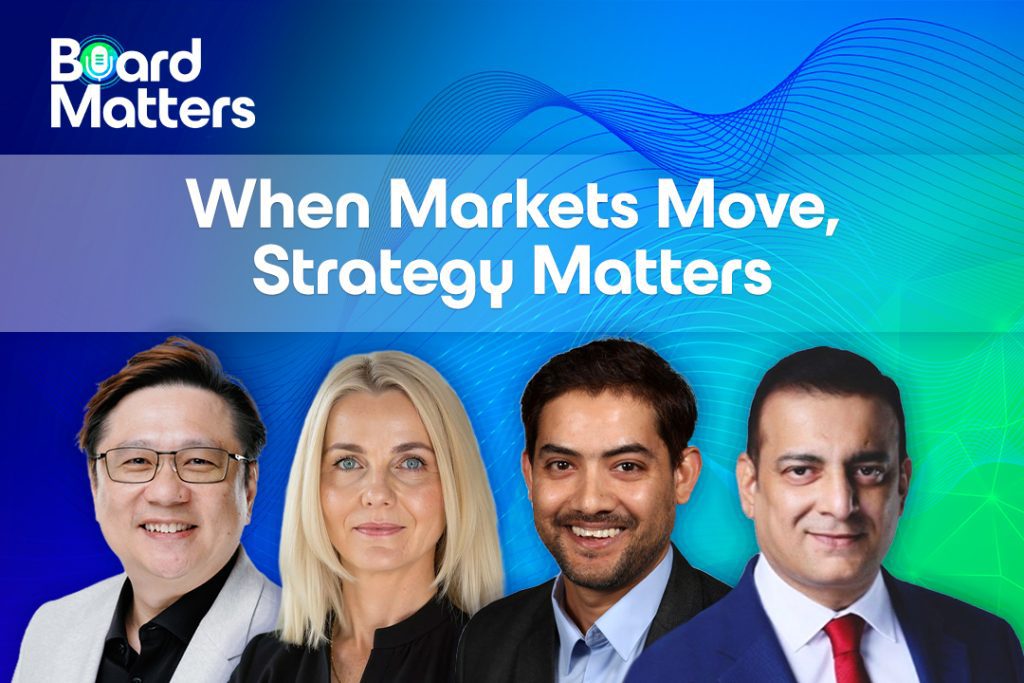
Kim Stewart-Smith – Founder and CEO of Stewart & Smith Advisory in Australia – has observed a significant change in how boards approach technology.
“Boards traditionally have treated technology as a spend item or a control kind of a risk,” she said. “They’re controlling the spend, managing the risk and signing off on projects that get presented to the board.”
That relationship is changing.
“Technology has now moved out of the risk committee,” Stewart-Smith explained. “It’s now sitting as an agenda item on the strategy agenda.
“It’s no longer, what are we spending on IT? It’s what does technology make possible for us that it didn’t before and are we positioned for it? Are we going to be disrupted by it?”
For Rahul Shinde – CIO of Coca-Cola in Vietnam – however, greater boardroom visibility doesn’t automatically translate into stronger accountability. This challenge is particularly pointed.
“Who loses the bonus if the strategy or the outcome is not achieved 18 months later?” Shinde challenged.
The question goes to the relationship between technology investment and the commercial results promised when that investment was approved.
“Do the boards question people who sign up on that business case, whether the outcomes that were presented in the business case are actually getting delivered?” Shinde asked.
Consequently, accountability must extend beyond the technology function.
“One of the questions I always ask the board whenever we start any transformation initiative is what outcomes are we looking at?” Shinde added. “And then who are the people who will form the committee to really drive that outcome?”
That could involve finance, commercial teams, product owners or other business functions responsible for delivering the intended benefits.
“We need to really look at that as a community and a joint ownership,” Shinde noted.
For Shinde, the problem arises when transformation is treated as a technology project rather than an organisational commitment.
“If you treat an initiative as a technology initiative and it’s the CIO who loses the bonus, then it’s never going to succeed when you look at developing a capability for a strategy,” he outlined.
Technology can enable transformation, but the business must ultimately own the outcome.
Greater strategic importance also places more pressure on boards to determine which technology investments deserve support. AI provides a particularly revealing example.
“I’ve seen one pattern that every presentation has AI in it, more than the actual business problem,” Raut observed.
“That’s not a good sign. Technology is coming first, then the outcome. We’re all talking about what model we should use rather than what problem we should solve.”
The danger is that enthusiasm for emerging technology starts determining investment priorities before organisations have established the business problem.
Raut prefers to reverse that sequence.
“Let’s discuss the problem first,” he advised. “Then we talk about the decision, and then we talk about the technology at the very last.”
Raut also questions how much of the activity labelled as AI transformation is genuinely different from existing business improvement programs.
“If you remove AI from every presentation, actually nothing changes – it’s the same thing what you had before,” he highlighted.
The observation reinforces a challenge explored in the previous episode of Board Matters – AI in the Boardroom – which stated that moving beyond experimentation requires organisations to demonstrate measurable enterprise value, not simply more AI activity.
For Shinde, board scrutiny must also extend to investments that protect the business rather than directly generate growth. Cyber security is one example where technology leaders need to change the conversation.
“The CIO’s role is to really provoke the board to understand the financial consequences of not doing certain things,” he said.
Rather than concentrating solely on audit findings, vulnerabilities and compliance posture, boards must also examine the operational consequences of disruption.
“If we suffer a ransomware attack, or a cyber attack, what is our risk appetite?” Shinde asked.
“What is our time to recover our operations and how long we should be able to sustain that? That’s where I think the CIO has to play the role of translator, so to say, not in terms of technology, but understanding the consequences and building that resiliency as a muscle.”
For Keith Sng – Field CTO across Asia Pacific and Japan (APJ) at Veeam – this is reflective of a similar challenge across technology investment more broadly in the region. Organisations making stronger decisions are not simply asking which technology to purchase.
“They are basically asking, what must we be able to do no matter what happens?” Sng expanded.
That changes the basis for prioritisation.
“You’re not effectively choosing between AI or cyber resilience,” Sng continued. “You are probably asking whether the foundation is solid enough to run both.”
Sng believes many organisations continue investing in AI, cloud and automation without sufficiently examining the data and resilience foundations supporting those initiatives.
“Boards that haven’t had that conversation yet are building on an assumption that they haven’t tested,” he added.
The implication connects directly to the first episode of Board Matters – Cyber Risk is Business Risk. Resilience cannot remain an isolated technology concern when disruption has financial, operational and reputational consequences for the enterprise.
The challenge becomes more difficult when short-term performance pressures compete with longer-term investment priorities. For Raut, this problem is all too familiar for technology leaders across the region.
“We as the technology leaders are very good at solving problems, but the problems are basically yesterday’s problems,” he said. “If something breaks, something changes, we step in, we fix it.”
That responsiveness can become an organisational weakness when every problem requires another intervention.
“In technology, we are very good at firefighting,” Raut added. “But the problem is we’re ending up having to make a bigger fire brigade every year.”
Costs increase. Teams expand. Yet the underlying problems continue.
“We need to solve the root cause, not the symptom every time,” Raut noted. “The whole idea actually is that we need to focus as a leader – not to solve the problem for today but by making tomorrow’s problem much easier to solve.”
Shinde believes this requires greater discipline across the entire technology investment portfolio.
“The CIO’s role is to ensure that we have the right portfolio coherence, so that all the IT investments are aligned to those capabilities that we want to build,” he explained.
That includes the willingness to discontinue initiatives that no longer support the organisation’s strategic direction.
“To ensure that all of the digital initiatives are not running in silos or they’re not satisfying individual stakeholders, but they are contributing or tied together to the long-term objectives,” Shinde added.
But investment discipline alone is insufficient. Shinde argues that operating models, decision rights and talent are equally important to sustainable transformation.
“If you can hire talent that is very capable but they do not have the authority or decision rights to drive change, then they will leave,” he cautioned. “If you’re in the middle of transformation – and you see teams coming and going – that’s a leading indicator that that transformation is not going to succeed.”
Without the right authority, incentives and organisational structures, even capable teams can struggle to deliver. Sng approaches sustainable growth through resilience.
“The organisations that are genuinely translating technology into sustained growth aren’t running transformation and resilience as competing priorities,” he said.
“Instead, they recognise the ability to operate continuously through disruption as a competitive advantage. Competitors who can’t recover fast are handing market share to those who can.”
For Sng, resilience is therefore much more than a technology protection investment. It is a capability that enables the organisation to continue operating while competitors may be unable to respond.
Volatile markets create pressure to respond quickly, revisit priorities and pursue emerging opportunities. But faster decision-making is only valuable when organisations remain clear about what matters.
For Raut, the board’s most important contribution during uncertainty is precisely that clarity.
“When the market becomes very uncertain, the most important thing that boards should do is to have full clarity on the priorities,” he said. “Because in those moments, the pressure keeps coming. You have to react fast otherwise you start chasing multiple directions.”
Shinde similarly believes short-term volatility shouldn’t prevent organisations from investing in the capabilities required for long-term performance.
“My plea to the board is to keep investing in the future – both from a growth standpoint as well as from a resiliency perspective – because long-term sustenance does not depend on short-term variations,” he added.
When markets move, the organisations best positioned to grow aren’t necessarily those investing the most. They’re the ones making clearer decisions, holding investments accountable and building the capabilities to keep moving when conditions change.
To watch the full episode of When Markets Move, Strategy Matters – click here.
Board Matters – in partnership with Moxie Insights and Veeam – hosts the most forward-thinking directors, chairs and executive leaders to unpack the strategies shaping today’s boardroom
Inform your opinion with executive guidance, in-depth analysis and business commentary.

