
Home
You’re currently viewing our content for All Regions.
You can switch to a different region:
July 29, 2025
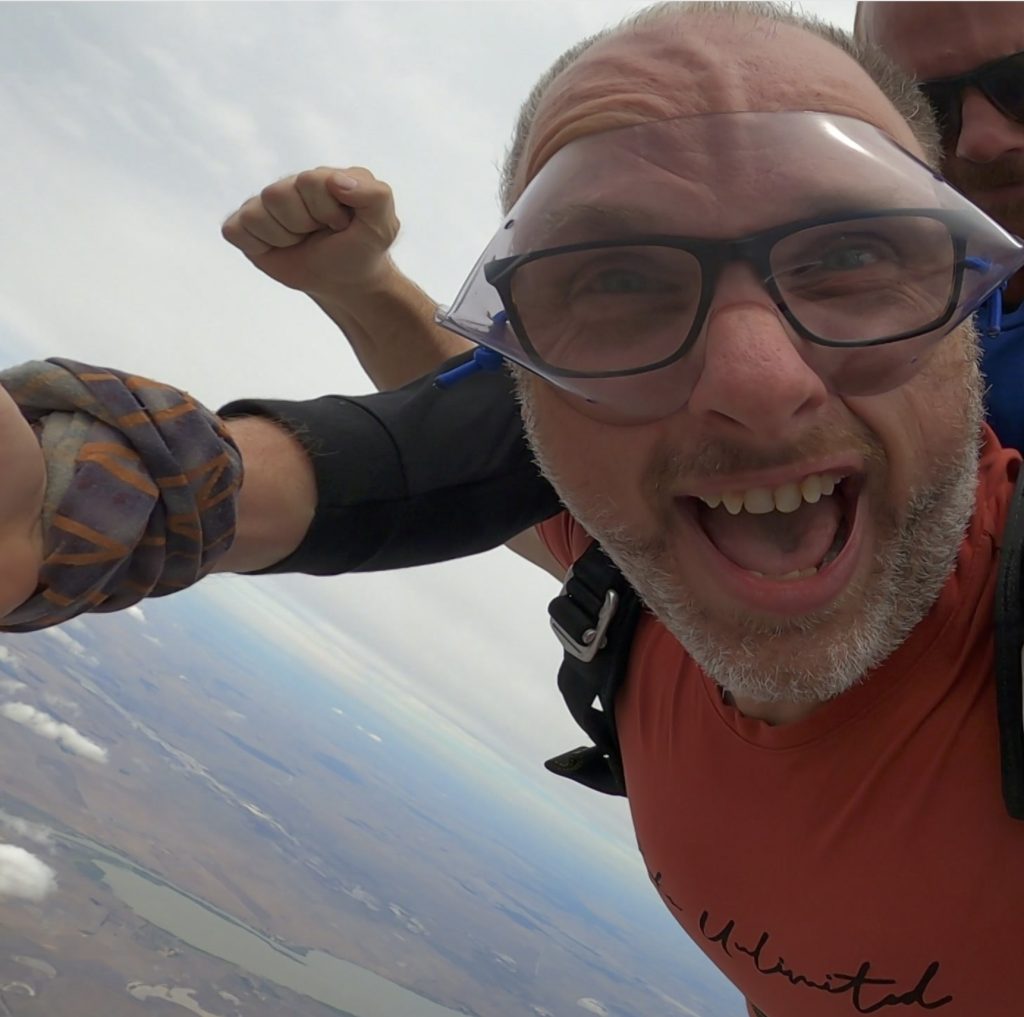
That strange mix of adrenaline and silence – heart pumping, mouth dry. Not sure if it’s an intense focus or fear-induced paralysis.
Brett Lodge looked over at his project manager.
“Nah, I can’t do this.”
Before his powers of persuasion could be deployed, a second voice cut the tension… “Okay, we’re going.”
Plane door opens – wind roaring, engine deafening. As the light switches from red to green, the screams become soundless and the world becomes narrow.
It’s go time, at 15,000 feet, above Adelaide.
“Luckily, as I was coming down, I looked up and she actually did the jump,” Brett recalled. “They had to circle around but she did it and that was such a massive shift.
“It creates a completely different thought process in your head. Everything you thought was entirely impossible becomes achievable – actually, maybe, this is possible now.”

Not many leaders start a two-day company strategy offsite with ‘mandatory’ sky-diving over South Australia. But for the Managing Director of Subnet, conventional rules don’t apply.
“I gave the team a month of notice, which was enough time to accept their fate,” shared Brett, armed with a wry smile.
“The rule was that unless you came to me directly and explained why you absolutely could not do this, then it was for everyone to do. We had one person who isn’t good with heights sit it out but aside from that, everyone else got suited up and jumped from 15,000 feet.”
In tackling the highest altitude jump without oxygen assistance – and free-falling for 60 seconds – this wasn’t some cruel gimmick designed to terrify team members. Quite the opposite, it was as compulsory as it could be without ever being compulsory.
“We talk a lot about shared experiences because this is when you start to build a foundation upon which everything else will sit,” Brett explained. “Yes, I like doing things a little different and I’m quirky that way but there’s method behind the madness.
“The team was so amped up that first night. It dominated the conversation and even those that opted out lived vicariously through the people that did it.”
From fear and freedom to complete euphoria, such sentiment carried into the 12-month strategy planning sessions during the next 48 hours.
“Everyone was so much more creative and the feeling actually lasted for months – people obviously still reference and talk about it today,” Brett added.
With an annual commitment of taking team bonding to the absolute extreme, Brett is continually building up a list of comfort zone killing activities.
“We’re thinking either shark diving or lion feeding – it’s just a matter of what we do next because we’ll keep this going,” he confirmed.
Embrace change, challenge legacy mindsets
Before officially joining Subnet in 2010, Brett held services management roles for more than a decade at Corporate Express, Commander and Centari Systems.
This expertise – combined with over five years of ad-hoc conversations and consulting with Subnet’s leadership team – resulted in his recruitment to build a services business from the ground up.
“In my interview with Matthew Thom – who’s now my business partner and still holds directorship at the company – I told him that I wanted to see him relaxing on a beach somewhere in the future,” Brett recalled. “My desire was to take over and run the company.”
Subnet is an Adelaide-based managed service provider (MSP) with expertise across cloud, cyber security, infrastructure and networking, in addition to back-up, modern workplace, end-user devices and unified communications.
Founded in 2000, the business has been trading in South Australia for 25 years with a customer base spanning all major industry sectors.
“When I joined, we started to move from stagnant to accelerated growth from the outset,” Brett said. “My approach was to come in and try to smash absolutely everything from day one.
“Perhaps security was a little lax back then because I was given the keys to the office and I was turning up at 4:30am in the morning and working until 7pm at night. Those 12-14 hour days were relentless.”
Nothing was off the table. An immediate change came in the form of a company dress code – out went the polo shirts and in came the suits. This was a business with a lot of growing up to do.
Clientele expanded into law and accountancy firms, customer conversations evolved and employee attitude changed.
Such an attitude change morphed into a new perception of value, an overhauling of billing and an increase in contract value and deal velocity. Suddenly, engineer hours were tracked, project reports were issued and systems were implemented.
“A couple of staff got pissed off that they had to go and buy proper shirts and pants on that first weekend but we found that it helped change everyone’s perception of themselves,” Brett qualified.
“The customer perception changes anyways but the team started acting more professional and we became more professional in terms of how we ran the business.”
The look and feel of Subnet – once a sleepy MSP in South Australia – transformed overnight. Alterations were small but daily and while the vibe change was striking, the shift in perception was stunning.
“We knew then that we weren’t the same people and we wouldn’t be doing the same things,” Brett added.
“Everyone jumped on the coattails and when we made other changes further down the path, they were more accepted because the business knew that change was always coming.”
Following 12 months of incremental iterations – in other words, “getting the basics out of the way” – Brett and the business realised a doubling of services revenue from $150,000 to $300,000. All achieved within those first 100 days.
As it turned out, that was the monetary cost of Brett jeopardising his health.
“One of the lessons that I’ve learned is that wasn’t particularly healthy,” he acknowledged.
“For a long time, I was the guy who worked 16-hour days for months and months, including weekends. Then I’d get sick for three or four weeks because I was totally burned out and completely trashed.”
Despite understanding the short- and long-term damage to his mental and physical health, Brett struggled to adapt given such a work ethic was ingrained into his psyche from an early age by his father.
At the extreme, working hard was undoubtedly in his DNA but on occasions, working smart wasn’t even in his vocabulary.
“I also realised that everyone was following my lead no matter how much I told them that it was just my process that I had to follow,” Brett expanded.
“I learned that it doesn’t matter what you say, when you’re the boss people follow what they see. It wasn’t a long-term viable product and I couldn’t afford to keep being sick all of the time.”
Today, Brett has built a pragmatic compromise into his daily routine. The aim is to start at whatever time that is required – he is a morning person after all – but leave by 3/3:30pm in the afternoon.
“That way I can come home, make dinner and be with the family which provides that little bit of breathing space to ensure I don’t burn myself out,” he said. “It’s changed my brain and mind which means the late night work has tapered off.”
Crossing the “chasm of despair“
The blood, sweat and tears from Brett, Matt and the wider team wasn’t a guarantee of success however.
“It’s important to be very open and honest, which we do with the team as well,” Brett noted.
In the early days, Subnet was invited to join an exclusive Cisco program based in France. As a “massive partner” of the vendor at the time, not many companies were selected from Australia to attend this service leadership initiative.
“They looked at all of our numbers and came back with a report about our business,” Brett explained. “We’d been growing as a services focused company that was all about services – our managed services were pretty basic at that point but we were doing well with project work also.
“We opened up our books and provided a tonne of information. Our numbers were definitely growing and at the time we were about $6 or $7 million in revenue.”
Books opened. Numbers submitted. Reasons to be confident.
Until the verdict.
“You’re not a services company. You realise that, right?”
“What the hell are you talking about? Our entire drive is on services.”
“No, no. Based on your numbers, you are absolutely a 100% product focused company.”
That was a bitter and brutal pill to swallow.
“We were shocked because we assumed we were heading down the right path,” Brett admitted. “We started questioning all of our life choices to a certain degree, especially about why we weren’t selling enough managed services. That stuck in our mind for a while.”
The domino effect was devastating for a business that had already made a 180-degree strategic pivot. Another shift of similar magnitude would result in the company being back at square one, without a clear or consistent path forward.
“When we started to rectify that and become serious about being a services company, we entered the ‘chasm of despair’ as they call it,” Brett said. “That changeover from one-off sales to annuity sales hit us very, very hard.”
For many MSPs, the shift from one-off sales to annuity-based revenue often leads them into this so-called “chasm of despair” – a critical and uncomfortable phase where short-term financial strain collides with long-term strategic change.
Traditionally, technology providers have thrived on upfront, project-based deals that deliver immediate cash flow.
However, transitioning to a recurring revenue model requires selling lower-value, subscription-like services that build over time. This creates a temporary cash flow gap – project income slows, while the predictable annuity stream hasn’t yet reached a sustainable level.
“During the process of changing everything over, we lost of tonne of revenue and therefore, a tonne of gross profit,” Brett detailed. “We used to rely on decent sized rebates from Cisco and other vendors but we hit that chasm very hard.
“The business was looking promising but we were losing money hand over fist and almost reached the brink of shutting up shop and doing something else.”
It reached the point when Tom Black – Finance Manager at Subnet, and Director between 2000 and 2017 – called in the leadership team and outlined what was required to stop the business bleeding cash.
Brett switched from General Manager back to Project Manager and the company lost a sizeable portion of staff.
“That was a very tough point,” Brett highlighted. “You have to keep growing to get through the chasm but we weren’t growing at the rate that we needed to, so the income dried up because we weren’t focused on selling product as much.
“We were basically living hand-to-mouth and every single day was about chasing the next deal. Otherwise we wouldn’t have been able to pay people.”
The pain continued unabated for 12-18 months with leadership taking pay cuts to best weather the storm and protect critical staff from redundancy.
“We kind of knew it was coming but then we had a bad year in general and both of those dropping off meant that nothing was sustainable,” Brett revealed.
Fast forward over a decade to COVID-19 and the business relied on monthly managed services revenue to sustain the entire company – paying all staff at the same level and ensuring all bills were paid on the 1st of each month thanks to recurring invoices.
“If we had a massive project then hallelujah but damn, that took us five, six or even seven years to reach that point,” Brett summarised. “The chasm hurt for a long period but since then we’ve had some very good years, including during COVID-19.”
Coming out of the other side is not without company battle scars however. Scars that shape new decisions and help future-proof business operations.
“If you build it, they will come – that turned out to be a bullshit approach,” Brett analysed. “We used to think that if we built an offering then everyone was going to really love it and just use it… but they never did.”
Citing cloud back-up as a case in point, Brett shared how Subnet invested hundreds of thousands of dollars into an area of the market that failed to yield a return.
“Everyone was talking about build your own infrastructure so we invested $200,000 in a server and started down that path,” he shared. “We used a proper change management approach but despite building it, the customers didn’t come. It didn’t work.”
Instead, Brett recommended “build what you can sell, right now”, then worry about the bigger picture later. Otherwise, MSPs risk striking a “very dangerous” balance with little room for manoeuvre.
“Work with customers that are actually paying the money because even though you think it’s valuable, that doesn’t mean it actually is,” he assessed.
Hence why grand gestures on conference stages by vendors advocating for partners to adopt the latest and greatest technology often falls on deaf ears within the MSP community.
Build a security practice? You won’t find much change out of a couple of million and that’s just on the staff, forget the technology investment.
“It’s just crazy,” Brett added. “Especially in South Australia, this is a very small market and you can’t realistically charge $20,000 a month for security services so you have to be practical.
“We built up our security capabilities over time, one-by-one and that was a sustainable approach. We started by adding endpoint detection and response [EDR] products and then gradually enhanced our portfolio rather than building an entire security stack.
“We had to learn our lesson from spending $200,000 one year to writing off that same $200,00 only 18 months later. Don’t build versions two, three and four on day one.”
The value of when to strategically leverage people also came into sharp focus post-chasm.
At one point in Subnet history, potential hires were advised to wear suits to interviews because if the discussion went well, they would be sent out on site the same day. That type of rapid growth was commonplace in the early and mid 2000s before the global financial crisis (GFC) but is no longer viable in a managed services world.
“That really changed our mindsets,” Brett said.
“In one of my peer groups, I now hear people say that they have to be ‘bleeding from the eyes’ before they would even consider bringing a new person into the business. You must have a real need today but for a while, a lot of companies hired people for the sake of hiring people.”
By extension, that also casts doubt on the “family culture” description that dominates LinkedIn feeds today. The industry is obsessed with building businesses on the perceived pillars of family values but is that a true articulation of reality?
“We talk a lot about trying to feel like a family but the business doesn’t feel like a family,” Brett volunteered.
“I’ve come to the realisation in the last couple of years that you don’t want to inspire a family culture, that implies you have to keep people regardless. Instead, you want a team culture in which everyone joins together and creates value.”
Personal growth, scaling success
As a business, Subnet has progressed through different versions over the years. Subnet 1.0 was focused on operational managed services while Subnet 1.5 incorporated cyber security capabilities into its core offering.
Subnet 2.0 prioritised business intelligence (BI), data analytics, automation and artificial intelligence (AI) both internally and externally.
Key words also drive annual decision making, such as “automation and self-service” in 2024. This created space to “open up every single part of our business” in the pursuit of improved efficiencies and maximum investment returns.
“Every .0 release is a relook and acknowledgement that the market has changed,” Brett summarised. “We make those ’starting from scratch’ changes every five or so years which relaunches the business and our approach.
“We are now entering Subnet 3.5 and have a different look to our managed services offerings – being mindful that Subnet 4.0 is on the horizon. We are constantly versioning our capabilities and adding small changes along the way.”
Navigating the chasm demanded strategic patience, leadership alignment and faith in the long-term value of recurring income. It was painful – but necessary – for sustainable growth.
In parallel, Brett also evolved as a person and leader.
“You absolutely can’t scale if you’re the only person making all the decisions,” he realised.
In response, Brett built an internal program called ‘Next Level Leadership’ to develop the next generation of Subnet leaders. This is aligned to a skills matrix and is differentiated between leadership and manager positions.
“We rate people on the matrix scale and they also rate themselves,” Brett explained. “That way, we’re all on the same page and can look at the gaps and make improvements and recommendations as we progress.”
Through this shift in focus, new leaders continue to emerge and the Subnet business continues to scale.
“Like I said to Matt on day one, I have the view that people should be primed to take over my role,” Brett added.
“My value is all about returning value to people but that can get in your head and make you think you’re letting everyone down if you’re not doing everything. But I’ve learned that doesn’t allow people to grow and you’re starving talent of learning something new.
“That realisation helped me get over my own personal chasm and the business is doing a lot better for it.”
The biggest indicator of that is Brett leaves the office at 3pm, and seldom takes his phone home.
“Getting over that hump was something that I had to come to grips with,” Brett acknowledged.
Inform your opinion with executive guidance, in-depth analysis and business commentary.

