
Home
You’re currently viewing our content for All Regions.
You can switch to a different region:
May 21, 2026
Amid all the market hype surrounding AI, clarity is fast becoming a competitive advantage in the Australian channel.
Just drop the distractions, block out the noise and focus on the growth potential.
“There’s a huge opportunity for partners in Australia to capitalise on the growth in AI,” advised Samantha Said, Senior Partner Development Manager at Microsoft.
Such a headline statement is backed by big local numbers – generative AI (GenAI) alone is expected to contribute $115 billion annually to Australia’s economy by 2030.
Most of these gains – approximately $30 billion to $80 billion – will result from increases in workforce productivity through the automation of routine tasks, according to a report from Microsoft and the Tech Council of Australia.

The augmentation of tasks using GenAI as a ‘copilot’ is expected to deliver between $10 billion and $25 billion in economic value. All invested into a nation housing 98% of small and medium-sized businesses (SMBs), equating to roughly 2.5 million companies.
Yet this is a partner ecosystem facing an AI identity crisis – questioning market positioning, doubting true value-add and unsure of a viable go-to-market strategy.
In other words, the money is there in SMB. But partners are struggling to keep pace.
“Partners should focus not just on positioning products with customers, but also adding your own human ambition,” Said added.
“What does that mean? It means adding change management, services and adoption around utilising this technology. That’s where the value for both partners and their customers is. Some partners have cracked this but not everyone has.”
Speaking at Crayon Connect 2026 in Sydney, Said advocated the benefits of partners leveraging the free tools available in Partner Center.
“Partners have access to renewal data,” Said explained.
“This offers deep insights into how customers are using AI and the opportunities for them to scale and gain more value. That’s where the opportunity lies for partners in the Australian AI ecosystem.”
Despite the daily challenges associated with differentiating within a competitive partner ecosystem, most sellers are not constrained by opportunity, rather time and signal.
According to Microsoft, up to 70% of effort is currently spent on administrative work meaning that portfolio coverage continues to expand while insight quality declines.
Sellers are forced to manually interpret fragmented telemetry across multiple systems, slowing decision-making and reducing precision in where they focus. The result is missed revenue signals, delayed interventions and inconsistent execution at scale.
Productivity is not just about efficiency, it is about enabling every seller to consistently identify and act on the highest-value opportunity, in real time.
To drive consistent, data-led growth across core solution lines, Said advised partners to connect to ASPX Insights within Partner Center.
Short for ‘AI Business Solutions and Security Partner Experience’, this provides direct access to adoption propensity models, customer telemetry and actionable account-level insights across Microsoft 365 Copilot, E7 and Agent 365 scenarios.
“This is the one area that partners should immediately take advantage of,” Said added.
“It shows which customers are using the free version of Copilot, how they’re using their licences today and what their utilisation looks like. That tells a partner whether they’re at risk of losing that customer and whether they’re actually using what they paid for.
“That matters because customers need to get value from what they buy.”
With customer data exclusive to the account holder, partners can then convert free licences to paid by adding services on top. Filtering options on the platform also support through selected Copilot opportunities highlighting the available incentives to ensure customers get the most value from their investment.
Said also highlighted the work of blueAPACHE – a managed service provider (MSP) that leveraged ASPX Insights to work with the first SMB customer in Australia to adopt Microsoft 365 E7.
Through E7, customers can accelerate the adoption of secure, agent-enabled AI at scale. This acts as a lower-friction entry point for customers to move from AI experimentation to enterprise execution, while enabling partners to lead with higher-value conversations around governance, security and operationalisation of AI agents.
“The team at blueAPACHE tied together a customer renewal opportunity with ASPX Insights,” Said shared.
“This is demonstrable proof that E7 is applicable for SMB customers – blueAPACHE moved from signals to results. Partners must now ask themselves – How are we acting on those signals? How are we building them into our operating rhythm and demonstrating the value to customers?”
To further capitalise on the AI opportunity, Said showcased the potential of CloudAscent – a platform designed to provide insights into which customers are ready to purchase Microsoft products.
Partners can receive updates about their existing SMB customer base while identifying new growth opportunities to strengthen lead generation and reduce user churn.
“This data is super useful to partners because it highlights which customers are ready to scale,” Said explained.
“It identifies customers with opportunity and helps articulate the dollar value attached to the deal. Partners are using this to prioritise high-value opportunities, generate new leads from their existing customer base and then build campaigns around those insights.
“If we talk about leaving money on the table, this is where partners can see what that money translates to.”
Global adoption of AI has continued to rise during the past 12 months, with roughly one in six people worldwide now using GenAI tools.
Based on the Microsoft AI Economy Institute, Australia is currently ranked 11th in AI adoption, behind New Zealand (7th) and the UK (8th).
Unsurprisingly, countries that have invested early in digital infrastructure – AI skilling, and government adoption – continue to lead, such as the United Arab Emirates (1st) and Singapore (2nd).
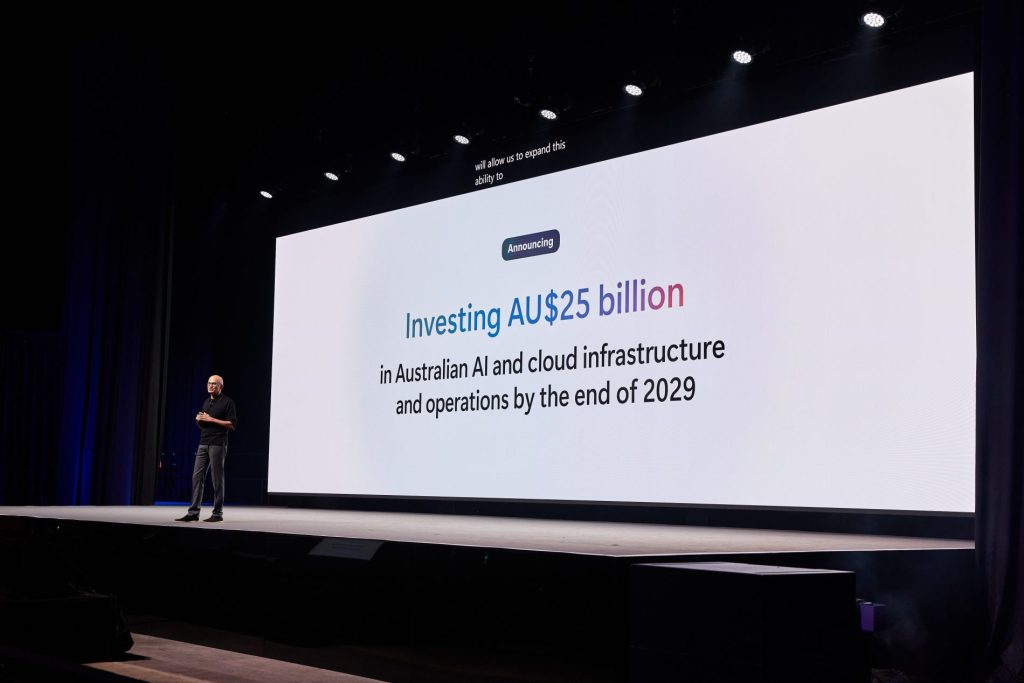
This suggests a sharp rise in adoption across Australia, following a $25 billion commitment by Microsoft to expand in-country computing and AI capacity by the end of 2029.
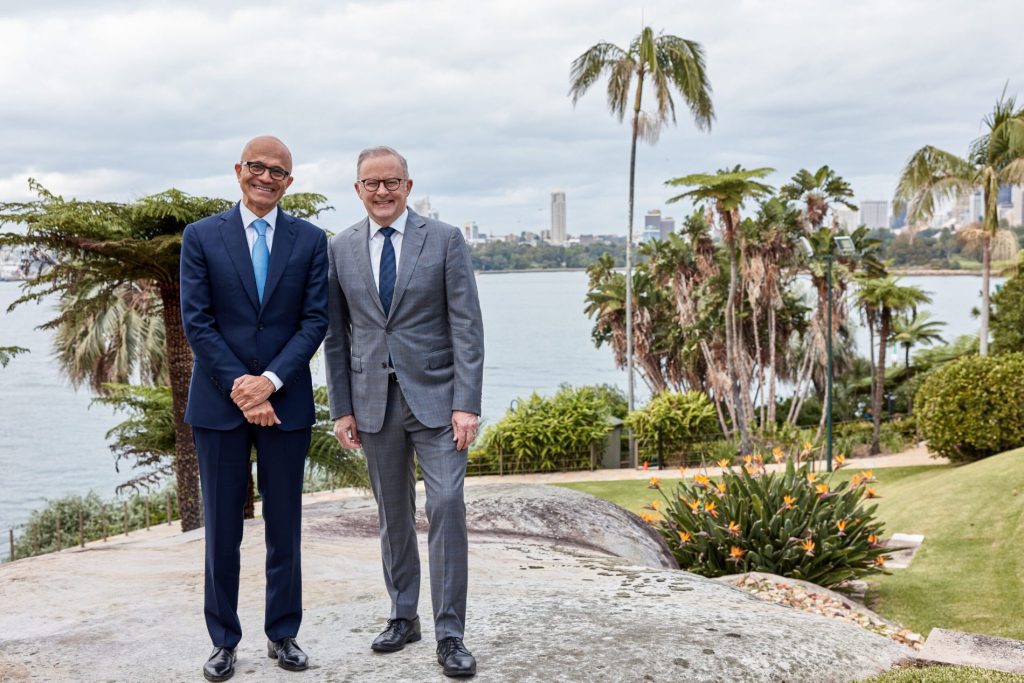
The new digital infrastructure investment was the headline of a high-profile visit to Sydney by Satya Nadella – CEO of Microsoft – in April, announced alongside Prime Minister Anthony Albanese.
At the heart of the capital and operational expenditure is the significant expansion of Microsoft’s Azure AI infrastructure across Australia, as well as enhancing local AI supercomputing capacity and deploying advanced AI processors to support the next generation of AI innovation, data and applications.
Microsoft will see increased growth across Commercial Cloud and AI/GPU offerings for customers in Australian cloud regions, with plans underway to expand its existing footprint by more than 140% by the end of 2029.
“This is a substantial investment in Australia,” Said added. “To capitalise on this investment, we will increase our commitment to AI skilling.”
Specifically, Microsoft will train three million Australians with workforce-ready AI skills by 2028 – the largest commitment of its kind ever made in the country. For the partner ecosystem, AI Skills Navigator represents an immediate starting point on this journey.
“AI skilling can be implemented without delay and partners must use the skilling available to them,” Said advised.
“We recommend getting your teams and businesses to use this. It’s personalised so you can tell the platform what your role is and how you want to learn.
“Partners always want to know where to start on AI. Our answer is internally.”
The most credible partners are becoming customer zero for their own AI strategies. Before selling transformation externally, they are pressure-testing tools internally – across operations, sales, marketing, service delivery and decision-making.
Using AI inside the business creates something far more valuable than a demo environment, however. This is lived experience – it exposes governance gaps, adoption challenges, workflow friction and measurable outcomes in real time.
Customers no longer want theory. They want proof. They want to know what worked, what failed and what changed operationally.
According to Said, becoming customer zero builds authenticity, sharper execution and stronger advisory capability. It shifts AI conversations from hype to practical business value grounded in first-hand experience.
“Partners must become customer zero and use the technology,” Said recommended.
“That becomes your customer story and the adoption story that you can take to market which will empower your sales and marketing teams because they will understand the technology by living it. If they’re not using AI, the messaging can easily become marketing fluff.
“From a personal standpoint, I can no longer do my own job without AI anymore. We’re all asked to do more and become more efficient, so how are you incorporating these AI tools into your own business?”
According to Said, SMBs are not harnessing AI as fast as they should be and it’s the role of Microsoft and its partner ecosystem to help them secure their platforms to enable growth and competitive differentiation.
As shared by Said, three key challenges are slowing down growth in Australia:
For partners facing questions related to selecting a large language model (LLM) in response to customers already aligning with a product, Said cautioned against putting all AI eggs into one basket.
“I would challenge that,” Said stated.
“You don’t need to go all in on Claude, nor do you need to go all in on ChatGPT. Microsoft is investing astronomical amounts into building partnerships so that customers have access to these LLMs by default.
“This is how best to use AI. When customers ask, which LLM they should choose, stop them there because that’s not the right question. The right question is, what platform are you putting your business on?”
As a long-standing distributor locally, regionally and globally, Crayon was honoured as 2025 Microsoft Regional Partner of the Year Award in Asia.
The award recognises Microsoft partners that have developed and delivered “outstanding” Microsoft Cloud applications, services, devices and AI innovation during the past year. This was due to “demonstrating excellence” in innovation and implementation of customer solutions based on Microsoft technology.
Crayon – who purchased rhipe for $408 million in 2021 – was acquired by SoftwareOne for $1.4 billion in 2025.
“Partners can leverage SoftwareOne and Microsoft to help unblock opportunities,” Said added.
“Microsoft is a major business partner within Crayon and we work together every single day to help partners grow their business in Australia. Our combined teams have the ability to tap into all of our programs and leverage that capability to advance your customers, implement AI faster and also earn money along the way.”
In a final message to the partner ecosystem, Said shared three next steps to capitalise on the AI opportunity within SMB across Australia.
“Partners are going to see a lot more of Microsoft throughout the course of this AI transformation journey,” Said summarised.
“So our takeaway is to please leverage us because we’re here to help. We want to see you succeed because we’re all in this together. It’s not about you winning alone – it’s about all of us winning together. And we’re here to help drive that.”
Inform your opinion with executive guidance, in-depth analysis and business commentary.

