
Home
You’re currently viewing our content for All Regions.
You can switch to a different region:
September 1, 2026
Technology has long celebrated the disruptors. The start-ups. The cloud natives. The AI pace-setters.
Businesses built for the next wave rather than the last.
This is a fickle industry fixated on the new with conventional wisdom – for what it’s worth – suggesting technology partners represent the exact opposite. Settling into the businesses they had always been, the longer they operate, the more they become entrenched, the harder it becomes to change.
You can’t teach an old dog new tricks.
“The market evolves and we have to evolve with it,” said Billy Apoleska, Head of Ecosystem across Australia and New Zealand (A/NZ) at IBM.
“IBM has always been ahead of the market in many areas and AI is a good example. Think back to Deep Blue in the 1990s but eventually the market catches up which means that organisations have to continually adapt.
“We need to adapt to changes in technology, we need to adapt to changes in the market and we need to adapt to changing customer expectations.
“The same applies to our partners. The partners who are thinking about their next long-term move – not simply their next transaction – are the ones positioning themselves for sustained success.”

Such partnering philosophy aggressively challenges one of business’ oldest assumptions in the age of the ecosystem. Not only can you teach an old dog new tricks but some of the most profound examples of reinvention involve legendary companies shifting core models to dominate new industries.
Amazon started as an online bookstore before expanding into general e-commerce and cloud. Netflix transformed from a DVD-by-mail rental service into a streaming pioneer.
Play-Doh was originally sold as a coal residue removal cleaner before pivoting to modelling clay for children. YouTube first entered the market as a dating website.
In the early 1990s, Lou Gerstner saved IBM from bankruptcy – reversing a staggering $8 billion quarterly loss by shifting focus to software, IT consulting services and computing research.
As history shows, you can most certainly teach an old dog new tricks.
“One of our biggest priorities this year has been recognising that the market has fundamentally changed,” Apoleska added.
“Our partners are engaging customers much earlier than vendors traditionally have. Historically, vendors often entered the conversation closer to the transaction but today, influence happens much earlier.
“If we’re not helping shape those early conversations, we’re missing the opportunity to create the greatest value.”
One word, more than any other, captures how the partner landscape has changed. Not AI and not cloud – rather, ecosystem.
For years, technology revolved around the traditional channel. That linear route to market where vendors developed products, distributors moved them, partners sold them and customers bought them.
Every participant had a clearly defined role and success was measured largely by transactions flowing through that chain.
That model still exists but it no longer reflects reality.
Engagements today often involve a spider web of specialist providers – spanning global systems integrators (GSIs), consulting firms, independent software vendors (ISVs), hyperscalers, managed service providers (MSPs) and niche industry experts working together on the same transformation initiative.
The traditional chain has evolved into a connected network of capabilities.
“Exactly – and increasingly those boundaries are becoming blurred,” Apoleska acknowledged.
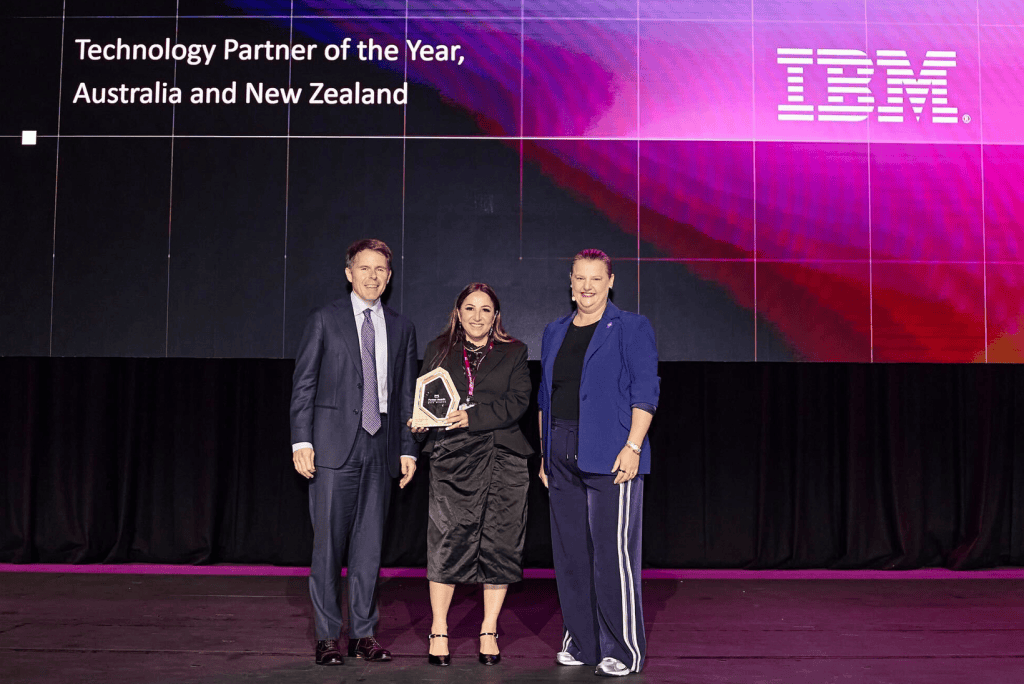
More than 1000 partners operate within the IBM ecosystem on both sides of the Tasman, with three Australian partners recently recognised on the global stage – Cloudec, Cortell and Pronto Software.
Cortell Australia – which operates as CorPlan in New Zealand – was showcased at the recent 2026 IBM Partner Plus Awards, taking home the Transformational SaaS Application honours in Asia Pacific.
“Take CorPlan as an example,” Apoleska shared.
“They’ve traditionally operated as a VAR for nearly two decades but they’ve recognised that becoming an ISV – building their own IP and taking a one-to-many approach – is what enables long-term scale. They’ve developed accelerators built around IBM technology and are now packaging that expertise to reach entirely new markets.”
The businesses were recognised for innovative work with IBM Planning Analytics, a software platform for planning, budgeting, forecasting and reporting.
“They’ve built deep domain expertise around financial planning and have developed their own IP on top of IBM technology,” Apoleska continued.
“They’re now expanding internationally and building partnerships to scale across Canada and the US. Here you have an Australian IBM partner that’s been in business for 18 years and is now taking Australian innovation to the global market.
“That’s exactly what a successful co-sell ecosystem should look like. They understand their industry exceptionally well, they know their customers and they’ve built genuine IP.
“What they didn’t necessarily have was the local reach into overseas markets, so bringing additional partners into that journey creates value for everyone involved.”
The work of Cortell and CorPlan demonstrates that the partners that will define the next decade will be the ones prepared to continually reinvent themselves. And IBM is armed and ready to support that ecosystem evolution.
“One important capability that we have is our Client Engineering team,” Apoleska added.
“They work with partners that want to build one-to-many solutions and they’re exceptional at design thinking. They facilitate workshops that help partners uncover opportunities they often didn’t even realise existed.
“They map out risks, they identify opportunities and then they bring IBM technology together with the partner’s own IP to co-create solutions that can be taken to market. That process is incredibly valuable.”

Through this team, IBM has partnered with several ISVs testing the limits of AI by helping define practice use cases that align with in-house solutions. Within that process, customers have also been brought deep into those conversations to validate requirements and test assumptions before development begins.
“We’re seeing growing demand for that approach and perhaps, some partners could leverage it even more,” Apoleska explained.
“Because importantly, it’s not just for ISVs. Traditional partners can also use that capability to develop industry-specific offerings by combining their own IP with IBM technology.”
Another example is Pronto Software, honoured as the Innovative Build Partner in Asia Pacific. The award recognises exceptional work bringing practical AI and data tools to everyday business users.
Pronto Xi – the company’s core ERP package – leverages the reporting capabilities of Cognos Analytics which is deeply integrated into the solution.
“Pronto is a long-standing IBM partner that originally embedded technologies such as our databases and Cognos Analytics,” Apoleska continued.
“More recently they’ve evolved into AI, building multiple AI use cases for customers while continuing to expand the value they deliver. It’s another example of partners evolving alongside the market.”
The success of Cortell and CorPlan – plus Pronto and Cloudec – are no long the exception, rather the best practice blueprints emerging for ecosystem excellence.
AI may dominate headlines but Apoleska argued that technology isn’t the biggest force reshaping the partner market. Customers are.
After several years of experimentation, organisations have become noticeably more disciplined in how they evaluate technology investment. The excitement surrounding AI hasn’t disappeared. If anything, expectations have become higher.
What’s changed is the standard customers now apply before committing.
“Clients are becoming much more deliberate about what they invest in and how they assess opportunities,” Apoleska observed.
“Decisions are increasingly based on measurable business outcomes and ROI. Gone are the days when we’d stand beside the fax machine waiting for a million-dollar purchase order to arrive. I actually did that once and I still remember the customer. But the market has evolved enormously since then.”
In short, transformation is now driving customer conversations and because of this, partners are no longer simply product resellers.
“Customers aren’t interested in being shown a catalogue of products anymore,” Apoleska added.
“Instead, they share a business outcome and want our partner ecosystem to help achieve it. They’re no longer asking us simply to recommend products. That approach has fundamentally changed how the ecosystem operates and that’s where our partners become incredibly valuable.”
Take AI as a leading example as the market shifts away from experimentation to execution. A recent meme circulating via social channels best articulates the current state of the industry:
‘Do you want AI?’
‘Yes.’
‘What do you want it to do?’
‘We don’t know yet.‘
“I think that’s exactly where the market has been,” Apoleska continued.
“Now we’re seeing our partners build the capability to properly define AI use cases before taking them to customers. They’re being very deliberate about understanding the domain they’re trying to serve instead of simply saying, ‘we sell AI.’ That’s a big shift.”
This approach is backed up by industry data. According to Moxie Research – AI Outlook: Australia 2026 – the most important characteristics that Australian organisations seek when working with an AI partner are:
“Sometimes it’s one, sometimes it’s both,” Apoleska said.
“We actively look for partners that combine industry knowledge with technical capability because they’ve already delivered those solutions repeatedly into that market. That experience matters.”
From a technology standpoint, IBM is also reporting “continued demand” specific to hybrid cloud and multi-cloud. But there is still confusion in the market.

“Many customers believe that having workloads across multiple cloud providers automatically means they’re operating a multi-cloud strategy, and that’s not necessarily the case,” Apoleska explained.
“We’re spending a lot of time helping customers understand the difference. Having multiple clouds isn’t the same as having a true multi-cloud operating model. You need to be able to provision consistently, move workloads easily and maintain governance and control regardless of which cloud you’re using.
“Our partners are building strong expertise in that space because delivering those transformation projects requires significant services capability. That’s where we’re seeing a lot of customer demand.”
Telling partners they need to evolve is one thing. Creating the conditions that allow them to do it is another.
That distinction matters because the ecosystem opportunity is becoming larger at precisely the same time as it is becoming more complicated.
“One key priority is ensuring that our programs continue evolving to meet the market where it is today,” Apoleska said.
“Another is strengthening our co-sell ecosystem. A third is helping partners expand across more of IBM’s technology portfolio and defining where the market is heading.
“Of course, growth is important as well. We want IBM to remain a strategic priority for our partners – not only because of our technology but because of the relationships, programs and opportunities we provide across the entire ecosystem.”
When creating a four-by-four matrix of priorities for the next 6-12 months, Apoleska acknowledged the ecosystem nuances at play.
A GSI has different needs from an ISV while an MSP goes to market differently than a VAR. The challenge is that every partner type has different priorities but to ensure growth, identifying what’s most important is critical.
“I also think that IBM is a quiet achiever,” Apoleska shared.
“We have one of the most mature partner ecosystems in the industry but we don’t always tell those stories well enough. I’ve challenged our partners to bring us more customer use cases. I want to showcase those successes.
“I want people to understand what’s actually being built and delivered across the ecosystem. We should be celebrating that much more loudly.”
Apoleska is enhancing ecosystem capabilities at a time of seismic market change.
Customers expect technologies to work together rather than exist in isolation while partners are moving between traditional resale, services, software development and IP.
In response, IBM has redefined not only how partners sell its technology, but how they access markets that might otherwise be difficult to reach.
“One major challenge is helping partners navigate the complexity of today’s hybrid world,” Apoleska continued.
Hyperscalers are a prime example, given the enormous committed spend programs in play.
The important question isn’t the size of that number, however. Rather, whether IBM partners can participate in the opportunity behind it.
“How do our partners access that opportunity? How do we make it simple for customers to consume IBM technology through partners using hyperscaler marketplaces?” Apoleska questioned.
IBM’s Designated Seller of Record model – or DSOR – is one answer.
The program allows partners to resell private cloud offers through hyperscaler marketplaces, giving customers the ability to consume technology through an increasingly familiar procurement route without removing the partner from the commercial relationship.
“Customers can purchase through the marketplace while the transaction still flows through the partner,” Apoleska explained.
“The partner retains margin recognition and, importantly, continues delivering the services around that solution. It’s a model that benefits everyone.”
That last point is significant because the hyperscaler opportunity doesn’t necessarily have to disintermediate the traditional partner. When structured correctly, it can actually expand its reach.
IBM is also addressing another long-standing obstacle to ecosystem collaboration in the form of internal incentives.
Partner-first strategies can sound compelling at a corporate level while becoming significantly more difficult when an individual salesperson believes working with a partner threatens their revenue recognition or commission.
Apoleska doesn’t dance around that reality – “a few carrots certainly help.”
This approach starts with an obvious question.
“One thing I’ve focused on is helping sellers understand what’s in it for them?” Apoleska asked. “Why should they proactively engage the ecosystem beyond simply following our governance and rules of engagement?”
IBM has responded in three ways. The first is formal co-sell recognition.
“IBM has launched a formal co-sell program where, if a partner like CorPlan sells into one of our customers, the IBM seller still receives recognition for that customer revenue,” Apoleska explained.
That changes the economics of collaboration.
Rather than seeing a partner opportunity as revenue being taken away, IBM sellers can actively introduce partner solutions while continuing to receive recognition for the resulting business.
“That means our sellers can actively take partner solutions into their accounts while still receiving credit for that success,” Apoleska clarified.
The second lever goes further.
“We have channel-neutral incentive uplifts,” Apoleska said. “In many cases, sellers can actually earn more by selling through partners than by trying to transact directly.”
The third is IBM’s Client Innovation Pilot program.
“Ecosystem funds those engagements, allowing partners and sellers to stand up solutions for customers without additional cost to the sales team,” Apoleska said. “That removes risk, it accelerates deployment and it increases influence within the account.”
Taken together, these aren’t simply partner incentives. They’re an attempt to remove the structural reasons that partner strategies sometimes fail inside large vendors.
IBM isn’t asking sellers to embrace the ecosystem despite their own commercial interests. It is trying to align those interests.
“When sellers understand those three things, they quickly realise the ecosystem isn’t competing with them – it’s helping them succeed,” Apoleska highlighted.
The same philosophy is changing how IBM measures partner success. A completed transaction is no longer necessarily the end point.
For software in particular, selling something a customer never properly deploys or consumes creates little long-term value for anyone involved.
“Selling software isn’t enough anymore,” Apoleska added. “We want to ensure customers actually deploy it successfully. We want them to use it. We want them to consume it.”
That thinking is now being reflected in partner economics.
“Our rebates and partner incentives increasingly reflect successful deployment and customer adoption, rather than simply closing a transaction,” Apoleska said.
It represents another important evolution in the traditional vendor-partner relationship. The transaction still matters but utilisation matters more than it once did.
Partner enablement has also become more complicated as IBM’s portfolio expands.
Acquisitions such as Red Hat, HashiCorp, Confluent and Apptio don’t simply add technology. They bring entire partner communities with them and that can create a different integration challenge.
“A major priority is making sure those partner communities have the right experience inside IBM and understand the breadth of the IBM portfolio,” Apoleska explained.
Many of those acquired businesses come with ecosystems at different stages of maturity.
“Our job is helping them understand how to leverage IBM’s broader ecosystem to accelerate their own growth,” Apoleska added.
But Apoleska sees the opportunity running in both directions.

Existing IBM partners now gain access to capabilities and technologies that weren’t previously part of their portfolio, while partners joining through an acquisition gain access to IBM’s much broader ecosystem.
Confluent illustrates the point.
“Existing IBM partners gain access to entirely new capabilities such as Confluent, which significantly extends what they can deliver around real-time data and streaming,” Apoleska said.
“At the same time, Confluent partners gain access to IBM’s much broader technology portfolio. Together, they can offer customers far more comprehensive end-to-end solutions than either could independently.”
For mature IBM partners considering their own reinvention, that effectively means the available building blocks keep changing.
A partner doesn’t necessarily need to acquire every new capability itself. IBM’s expanding portfolio – and the communities arriving alongside it – can create entirely new combinations of technology, expertise and routes to market.
Of course, a larger ecosystem creates another problem. Someone has to understand who does what.
Apoleska acknowledged that identifying the right specialist for the right opportunity remains difficult, particularly as partner capabilities become more sophisticated.
“I think it’s all of our responsibility,” she stated.
For example, IBM’s Partner Connect events are one mechanism for bringing partners together and exposing complementary capabilities.
Its sellers have another role.
“If a seller knows a major opportunity or tender is coming into their territory, they need to be thinking about how they assemble the strongest combination of partners to put IBM in the best possible position,” Apoleska noted. “If we don’t do that, we won’t win.”
That orchestration becomes particularly valuable when no individual partner can deliver everything a customer requires. Apoleska pointed to government tenders where IBM has brought multiple partners together because one organisation couldn’t provide every required capability.
“Instead of trying to solve everything alone, we brought multiple partners together,” she said. “Collectively they delivered a complete, end-to-end solution that none of them could have provided independently. That’s the power of co-sell.”
The final layer is distribution.
“People often reduce distributors to logistics but there’s so much more value than that,” Apoleska challenged.
“Today we expect them to help extend IBM’s reach into the partner community. Just as we talk about partners giving us greater reach into customers, our value-added distributors provide greater reach into the partner ecosystem.
“They have relationships and expertise that we simply don’t have. That’s valuable when we bring new acquisitions into IBM because they help us understand those markets and accelerate partner engagement.”
IBM has also resisted treating distributors as interchangeable, evident by the contrasting roles of Meier Business Systems (MBS) and Tech Data in the Australian market.
“MBS is highly specialised,” Apoleska shared.
“They focus on a core set of capabilities and execute exceptionally well while Tech Data brings global scale, extensive reach and world-class centres of excellence.” Our advice to partners is to explore both. Every partner has different needs, and each distributor offers different strengths.”
It neatly captures IBM’s broader approach. There is no single model for the modern technology partner, so there cannot be a single model for supporting one.
A mature VAR reinventing itself around proprietary IP requires something different from an ISV embedding IBM technology into its software. A GSI influencing a major transformation requires different support from an acquired Confluent partner entering the broader IBM ecosystem for the first time.
IBM’s strategy is increasingly designed around those differences.
Marketplaces create reach. Co-sell creates alignment. Incentives change internal behaviour. Client Innovation Pilots reduce risk. Acquisitions introduce new capability. Distributors extend scale. Partner orchestration brings the pieces together.
The common thread is that IBM isn’t simply asking partners to evolve with the market. It is attempting to evolve the machinery around them so they can.
Inform your opinion with executive guidance, in-depth analysis and business commentary.

