
Home
You’re currently viewing our content for All Regions.
You can switch to a different region:
August 19, 2026
The technology industry has spent decades perfecting the hand-off.
One company supplies the compute. Another takes responsibility for infrastructure. Facilities deals with power and cooling. Software provides visibility. Partners integrate the pieces. Procurement negotiates the capital investment before operations inherits the ongoing cost.
That model made sense when individual components of the technology stack could be considered, purchased and operated with a reasonable degree of separation.
AI is rapidly challenging that assumption, however.
As compute densities increase, power requirements escalate and cooling architectures change, decisions made at one end of the technology stack increasingly create immediate consequences elsewhere. Add software, energy, facilities readiness, sovereignty, governance and lifecycle economics into the equation and the traditional sequence starts to break down.
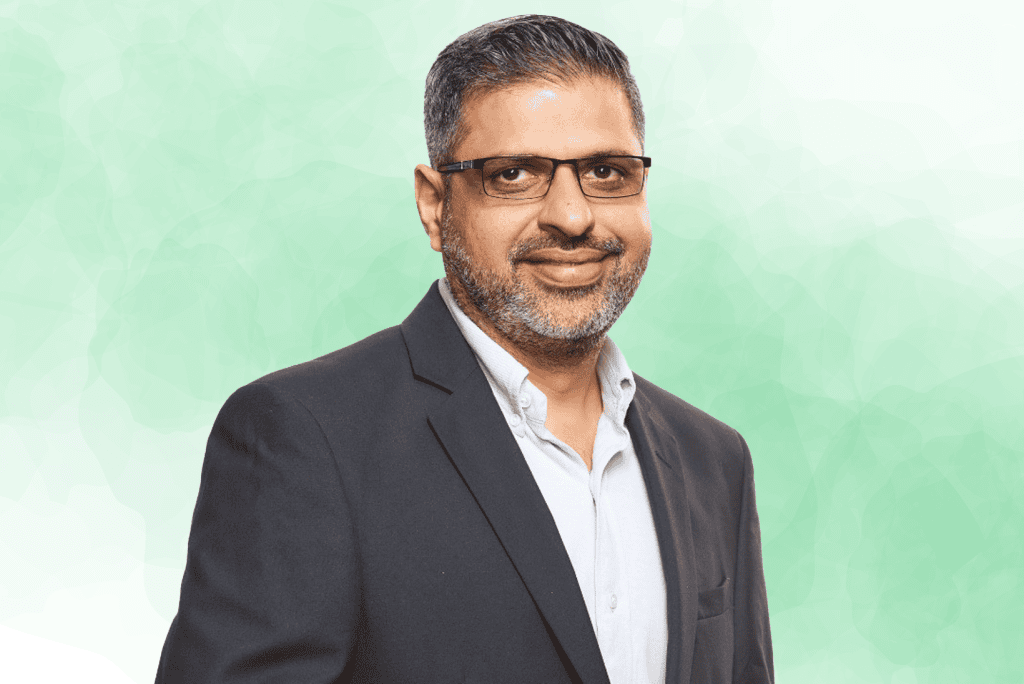
For Farokh Ghadially – Vice President of IT and Data Centre Business at Schneider Electric – this represents more than an infrastructure challenge, rather a change in how the technology industry thinks about creating and delivering outcomes.
“The future will not be built by products, the future will be built by ecosystems,” Ghadially observed.
The distinction matters.
Ecosystem has become one of technology’s most frequently used descriptions of partnership, often applied broadly to collections of vendors, partners and customers operating around the same market.
But Ghadially is advocating something more deliberate: an ecosystem mindset.
Rather than individual organisations optimising their own piece of a technology deployment before handing responsibility downstream, the starting point becomes the collective outcome. Infrastructure, compute, power, cooling, software and operational requirements move upstream in the conversation.
Because AI is not arriving in isolation.
Ghadially cited three forces developing simultaneously:
Customers are reshoring. Supply chains are being redesigned. Skills remain constrained. Sovereignty is moving higher on corporate agendas. Energy is becoming increasingly distributed while technology itself becomes more power-intensive.
The technology stack is becoming more interconnected at precisely the same time that the environment surrounding it becomes more complex.
For Ghadially, that combination changes the operating model.
“No one company will be able to solve the problem,” he said. “What our customers are looking for, what many enterprise customers in Australia are looking for, is technology and business outcomes.
“Now, this outcome, yes, it started with the conversation around compute, but it no longer rests purely with compute. You’ve got to think about power and cooling at the same time. You’ve got to think about facility readiness. You’ve got to think about software. You’ve got to think about visibility. You’ve got to think about sovereignty. You’ve got to think about governance.”
Social licence to operate is also becoming part of that conversation, particularly as the physical infrastructure supporting AI grows in scale and its demand for energy becomes more visible.
The ecosystem mindset is therefore less about assembling more partners around a deal and more about recognising that the outcome itself can no longer be separated into convenient pieces.
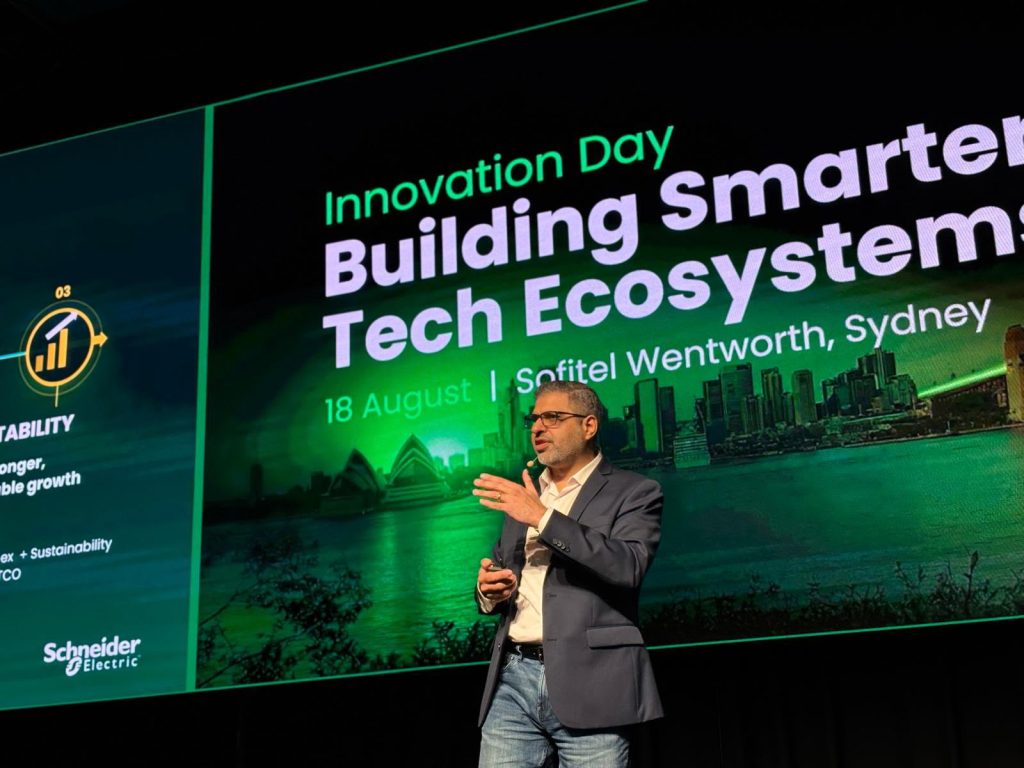
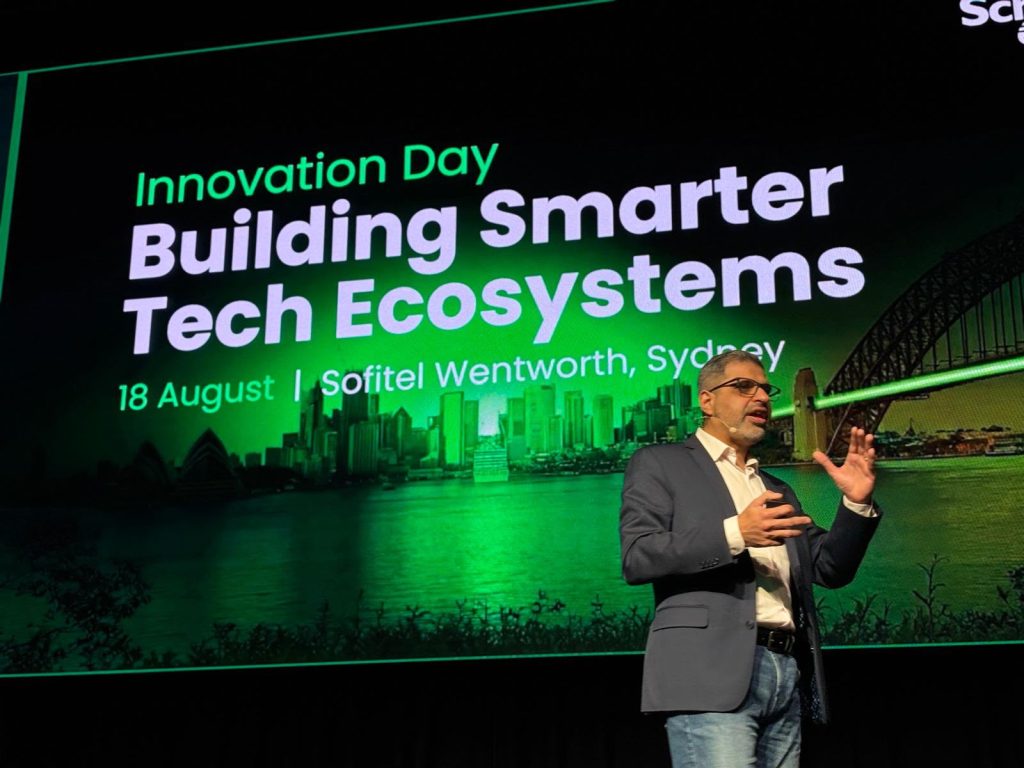
Ghadially shared the future of ecosystem in Australia during the headline keynote of Innovation Day 2026 – Building Smarter Tech Ecosystems – in Sydney.
The weakness in the existing ecosystem model is perhaps most obvious in the sequencing of infrastructure decisions.
Technology infrastructure has traditionally supported the IT decision. In the AI era, Ghadially argues that infrastructure increasingly needs to shape it.
“This traditional form of hand-offs worked when the scope was more separable,” he explained.
“We cannot operate in the traditional format. For example, infrastructure is generally an afterthought. We’ve sold the server in many cases, and then you try and figure out: does the building have enough power, or do we need cooling?”
That might once have created an inconvenience. At the densities associated with emerging AI infrastructure, it can become a fundamental design problem.
Ghadially pointed to an industry that only several years ago was accustomed to rack densities around 20 kilowatts but is now contemplating dramatically greater requirements.
“These chips are becoming hungrier and hungrier and hungrier,” he said. “It’s not uncommon to start thinking about 150 to 200 kilowatts per rack now as we speak. There’s already a roadmap for a one-megawatt rack.
“I say one megawatt. Our industry average three years, four years back was 20 kilowatts. Now imagine one-megawatt in the rack. This is the transition that we are looking at, and this is what’s going to change the game.”
In this context, power resilience becomes more important. Ghadially highlighted Schneider Electric’s research and development around technologies such as 800-volt DC, while cooling architectures must adapt as rack density moves beyond the practical limits of traditional approaches.
“We need to start looking at the entire power architecture as one,” he said.
An AI system may be assembled from individual components, but it cannot be designed effectively by pretending those components operate independently.
That is precisely where the hand-off starts to become the problem rather than the solution.
Much of the AI infrastructure debate has naturally concentrated on compute.
GPUs, accelerators, model performance and access to capacity have become central to technology strategy. Ghadially does not dispute their importance, but argued that focusing exclusively on compute risks misunderstanding where deployment constraints will emerge.
“The future of AI is not limited by compute,” he added.
“It is actually limited by how intelligently we build the infrastructure that powers that, or in fact, cools that. Compute only starts the conversation. To some extent it creates the conversation, but ultimately it’s infrastructure that makes it real.”
Greater compute capacity creates greater infrastructure dependency. Higher-density chips require more power. More power produces greater thermal challenges. Greater density affects facilities. Those facilities require monitoring and management. All of that influences operating costs, resilience and lifecycle economics.
The individual technology decision becomes inseparable from the environment supporting it.
“When we look at efficient power infrastructure, we want to look at the entire chain from grid to the chip, because our whole purpose is to power the chip,” Ghadially said.
That grid-to-chip view reflects a wider convergence between the technology and energy industries.
Electrification is expanding across homes, buildings and industry while energy generation itself becomes increasingly distributed. Renewables, batteries and changing power architectures are altering how electricity is produced and managed at the same time as AI increases demand for it.
“We’ve got all these distributed sources around the country, which need to now be arbitrated,” Ghadially said. “So it creates an interesting dynamic with the energy landscape.”
The relationship also works in the opposite direction.
“There’s a lot of discussion around the energy required to power AI, no question about that,” Ghadially expanded. “Yes, it requires power. The real question is, can we use AI for energy?”
The convergence means energy architecture increasingly becomes part of technology architecture – another traditionally separate discipline moving inside the same ecosystem conversation.
Ghadially is optimistic about what comes next, even while acknowledging the uncertainty surrounding a technology changing at extraordinary speed. He places the current shift into a much longer history of technological disruption.
“Not many of us were around when the first machine came in – that would be a miracle,” he said.
“But let me tell you, it was scary. The first time the motor car rolled out, it was scary. People were up in arms against it. We were scared when electricity was invented. But we got through it.”
AI, in his view, marks the beginning of another such period – what he describes as the era of intelligence.
“It’s a bit scary, but it is exciting, isn’t it?” Ghadially said. “We are at the right place at the right time as an industry. This is our time.”
The infrastructure required to support that era will not necessarily remain concentrated in enormous data centres. Ghadially sees AI itself progressing through distinct stages.
The first widespread wave of generative AI (genAI) has primarily been reactive – users asking large language models to generate content or respond to prompts.
“Today we are in this era of, let’s call it decision-making, where agentic AI is taking shape,” Ghadially added.
“This is where AI will now actually jump out from the data centre, from the server, and take true physical form. This may come in the shape of a car. This may come in the shape of a little robot who stands in your kitchen making food for you or cleaning up your house, believe it or not. But physical AI is here. It’s happening, and it will happen.”
As AI moves into physical environments, the balance between model training and inference begins to shift with processing needs occurring closer to where decisions and actions take place.
“The way data is managed will change, the way data is processed will change, and we will start seeing this transition from what we call training-based AI more into inference AI,” Ghadially noted. “With physical AI, you need to have capacity to process at the edge. So we’re forecasting that we will start seeing a rise of the edge.”
That leads Ghadially to challenge another prevailing assumption about AI infrastructure.
“When people think about AI, there’s a lot of press happening on this topic,” he said.
“AI means people are thinking large data centres. They’re thinking gigawatt data centres. Yes, there might be a few of those, but the magic is going to happen at the edge, and the magic is going to happen in this ecosystem.”
Ghadially expects a more varied AI infrastructure landscape encompassing large facilities alongside edge data centres, modular infrastructure and enterprise deployments.
“We think we’re going to see this ecosystem develop around AI, where we’ll have edge data centers, we’ll have edge pods of 0.5 to two megawatts, we’ll have rack-level infrastructure, AI infrastructure that starts coming into play at the enterprise level, and on-premises may start taking shape again,” Ghadially said.
“We need to match the AI workload to the right infrastructure.”
As that infrastructure becomes more distributed, so too does the ecosystem required to design, deploy and operate it.
Underlying this infrastructure expansion is an enormous imbalance between the amount of data organisations create and the amount from which they extract meaningful value.
Ghadially said humanity generated around 180 zettabytes of data during 2025, yet cited figures suggesting only a tiny proportion of global data is actually analysed and used to produce insights.
“This is the opportunity,” he said. “We’ve got all this data. A lot of it is unstructured. What can we do with this data is what will define this era of intelligence.”
AI provides one mechanism for extracting that value, but the same principle applies to the physical infrastructure underneath it because organisations cannot optimise infrastructure they cannot see.
For Ghadially, software therefore becomes the connective tissue across an increasingly complex environment – creating visibility from grid to chip to cooling infrastructure.
“How often are we deploying that value of AI to bring the right data to the fore?” he asked. “Software can provide visibility across that entire chain from grid to chip to chiller, bringing together power availability, cyber security, efficiency and safety.”
That shared view matters to the ecosystem mindset. If IT sees one environment, facilities another and operations something else entirely, collaboration still operates through organisational silos.
Shared visibility gives the ecosystem a common version of reality.
Australian businesses rarely approach technology investment wanting a collection of individual products. They want an outcome: greater capacity, improved productivity, stronger resilience, lower operating costs or the ability to deploy a new AI workload.
Yet the industry supporting that outcome can still organise itself around separate transactions.
A compute vendor can optimise compute. A power specialist can optimise power. A cooling provider can optimise cooling. A software specialist can optimise visibility. A systems integrator can optimise implementation.
Optimising every individual component does not automatically optimise the whole.
That is why Ghadially’s ecosystem mindset starts with connected outcomes.
“How do we get connected outcomes?” he asked. “Let’s think of that at the onset.”
From there, Ghadially identifies key practical shifts which, taken together, amount to an operating model for the ecosystem rather than simply a set of partnership principles.
Connected outcomes establish what everybody is collectively trying to achieve. Shared visibility gives those participants access to the information needed to understand the same environment.
“Can we use software? Can we use technology to bring shared visibility?” Ghadially asked.
Lifecycle thinking expands the timeframe beyond the initial transaction and forces organisations to consider what infrastructure will cost and require throughout its useful life. Then comes orchestration – connecting participants who have traditionally operated in their own areas of the market.
“Orchestrate the ecosystem and build the ecosystem,” Ghadially said. “Many of us have been in our little silos, operating, trying to achieve an outcome, which needs to change.”
The final shift is co-creation.
Instead of one participant designing an answer before successively handing pieces downstream, the ecosystem works together to determine the solution.
“Co-creation,” Ghadially said, is about “working together to create magic”.
That progression is important.
Outcome establishes the destination. Visibility creates a shared understanding. Lifecycle broadens the economics. Orchestration connects the participants. Co-creation changes how they solve the problem.
The ecosystem therefore does not assemble after the architecture has been decided. It helps decide the architecture.
The same mindset must also extend to how technology investments are measured. One weakness of the traditional hand-off model is that capital and operating costs frequently sit in different budgets, teams and conversations.
“Many times, capex and opex are never spoken about,” Ghadially said. “It’s a capex discussion, and we’re not thinking about how much it’s going to take to maintain. They’re separated. Accountability through these hand-offs becomes quite fragmented.”
AI infrastructure makes that separation increasingly consequential.
The purchase price of a system is only one part of its economics. Energy consumption, cooling, maintenance, utilisation, resilience and infrastructure lifecycle all continue long after deployment.
“What is your total cost of operation?” Ghadially asked. “It’s not only the capex cost. Are you looking at carbon costs at the time of setting up your infrastructure?”
This places sustainability inside the infrastructure decision rather than alongside it. It also broadens the ecosystem again.
Procurement may own the purchase. IT may own the workload. Facilities may own the energy bill. Operations may inherit the environment. Sustainability teams may measure carbon. Finance ultimately sees the economics.
The customer, however, experiences all of those decisions as one outcome.
Ghadially sees agility, intelligence and profitability as potential consequences of connecting them.
“If we are able to work together, if we are able to look at capex opex in the same breath, if we are able to put a cost to carbon up front during capex phase, profitability will surely increase,” he outlined.
Technology itself remains fundamental to everything, Ghadially describes.
AI depends on extraordinary advances in compute. Power technology will have to evolve. Cooling architectures are already changing. Software needs to create greater visibility. Infrastructure will need to become more adaptable and increasingly distributed.
But having access to those capabilities does not guarantee that they combine into the right outcome. That is the distinction at the heart of the ecosystem mindset.
In previous technology cycles, competitive differentiation could be heavily concentrated within a product, platform or individual layer of the stack.
AI distributes that dependency. The customer outcome increasingly rests on capabilities spread across different technologies, disciplines, companies and operating environments.
The scarce capability may therefore become the ability to orchestrate them.
For Ghadially, that also requires a different mentality from the companies and individuals operating inside the ecosystem.
“What has brought us here – and it’s a cliché statement – is not going to take us to the next step,” he recommended.
Ghadially’s call is for a growth mindset: challenge existing approaches, engage with expertise outside traditional organisational boundaries and make connections capable of creating business value for customers.
AI is increasing the capability of technology while simultaneously increasing the interdependencies required to make that technology work.
Compute is becoming denser. AI is moving towards the edge. Energy and technology architectures are converging. Sovereignty and governance are becoming design considerations. Software is connecting previously isolated environments. Lifecycle economics are becoming harder to separate from the initial technology decision.
The ecosystem already exists around those moving parts.
The challenge now is making it operate as one.
“The winners in this era of intelligence won’t be those with the most amount of technology,” Ghadially said. “The winners are those who can orchestrate the best ecosystem.”
Inform your opinion with executive guidance, in-depth analysis and business commentary.

