
Home
You’re currently viewing our content for All Regions.
You can switch to a different region:
October 13, 2026
Before taking his first proper work call in almost two years, Tristan Rajah asked his wife to take their two young sons out of the caravan half an hour early.
It was necessary preparation to reawaken a sleeping muscle.
“I asked Ainsley to take the kids out a little early because I needed to get my head in the game – just to be able to have an actual conversation and articulate a point.”
There had been plenty of conversations while travelling as a family around Australia. Other families wanted to know where they had been, their favourite spots and what lay ahead.
But an in-depth media interview – intensely personal and unashamedly authentic – felt different.
“I’m excited to chat, don’t get me wrong,” Tristan shared. “But I’m a little nervous because I haven’t had one of these discussions in so long.”
Opening LinkedIn felt worse.
Having been on the social network almost daily for more than 16 years – like every other working professional in the technology industry – to staying off the platform for 18 months cold turkey, reengaging felt like an out of body experience. Funny how the brain and body work.
“I felt weird in the stomach,” he said. “It felt really, really strange.”
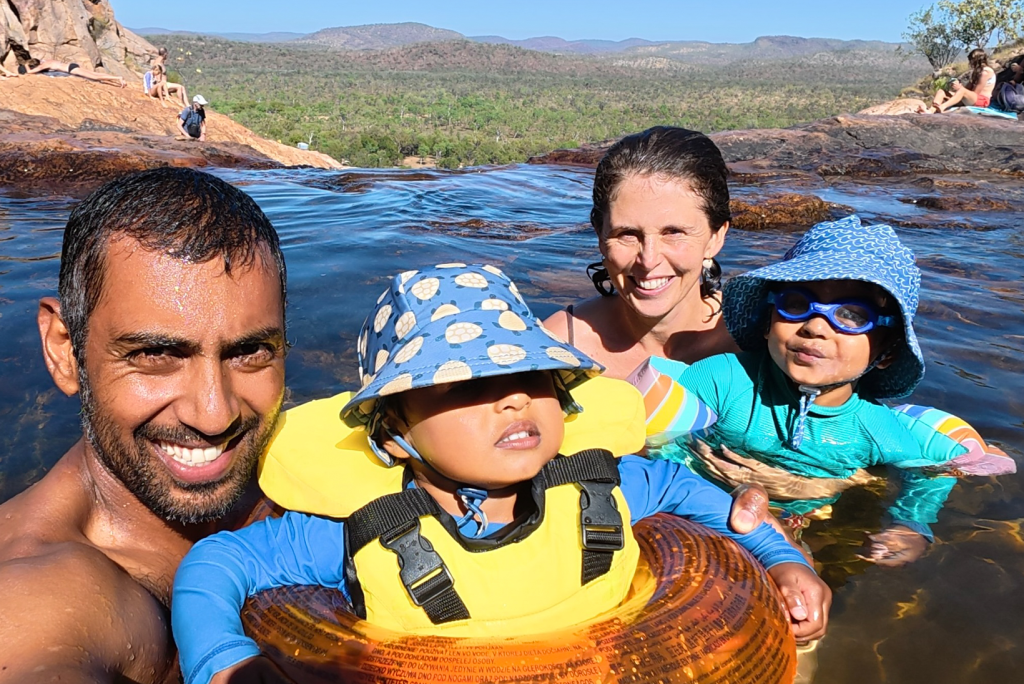
That morning, Ainsley had taken the boys – Hugo and Jude – to the Charleville Bilby Experience, in outback Queensland. As they left the caravan, Tristan was struck by how unfamiliar it felt to stay behind for something connected to work.
“This feels weird and it doesn’t feel right,” he said. “That’s going to be a really, really big change.”
Because after almost two years on the road – quitting corporate life to travel the length and breadth of Australia in a family caravan – being together had become ordinary life. Returning to Sydney and the industry would require adjustment.
“I loved my job and we love Sydney,” he added. “We love where we live, we love our life and we have our community there. This experience was just to simply do it as an experience – it wasn’t to get away.”
To be clear, a caravan trip around Australia had never featured in Tristan’s plans.
“I never grew up camping, caravanning or being outdoorsy,” he said. “Up until this trip, I didn’t spend that much time in nature.”
So much so that people who knew him were placing bets on how long he would last. Ainsley had more experience of camping and welcomed the adventure, but she assumed her husband would never consider it.
The idea emerged after the family caught up with friends preparing for their own trip.
“I kind of went to Ainsley afterwards, ‘why couldn’t we do that?’ But she laughed because in her head there was no way that I was capable of doing that,” recalled Tristan, with a beaming smile and head nod.
For the next three months, Ainsley remained unconvinced.
“I kept saying, ‘why aren’t you getting excited about this? I thought you’d be really, really keen on this adventure of a lifetime?.’” Tristan asked.
Then Tristan went for a run with Pat Devlin – his then boss at Aruba – and told him about the plan. When he came home and mentioned that conversation to Ainsley, only then did she realise that he meant it.
“Within two weeks, it was full steam ahead,” Tristan noted.
Telling other people was part of Tristan’s approach because each conversation made the commitment more tangible.
“The more I said it, the more I felt like I had to do it,” he said. “Once Ainsley believed me and became interested, then it was like, ‘okay, this is happening. I can’t back out now.’”
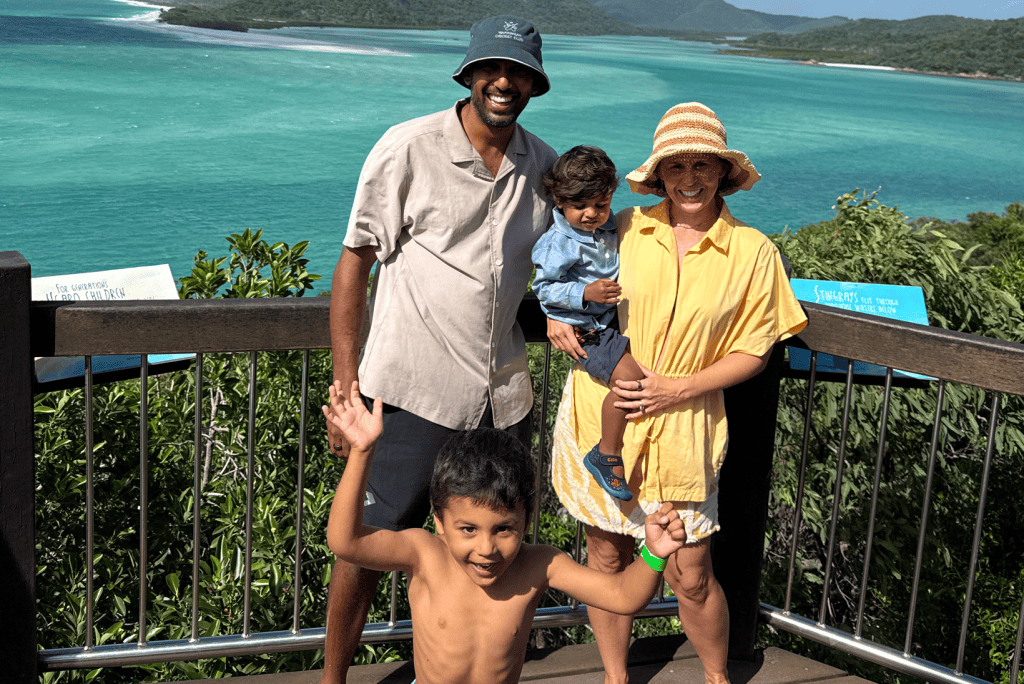
There were also practical reasons to act.
Tristan had accumulated substantial long service leave and annual leave during 14 years at Hewlett Packard Enterprise (HPE), giving the family financial room to travel. Hugo, their eldest son, was three when the idea took shape so school was approaching.
“If we were ever going to do it, this was the time before they started school,” Tristan said.
Tristan already valued the flexibility that HPE offered. Hybrid working had allowed him to be a present father and take time with the children but the trip would provide an experience that could not be replicated around a working week.
“My career had no bearing on the decision when we made it,” Tristan added.
“The decision was really around family and the ability to do something that most people would give anything to do. There’s no way I’m going to regret the family decision when things really matter later on in life. My mentality was that I’ll come back and I’ll find a job.”
After making the decision, the family initially expected to travel for 12 to 18 months. But once they hit the open road, they decided to keep going.
“We’re still here and we’re still doing it and yes, we’re probably never going to get this chance again,” Tristan confirmed.
“By the time we return, we’ll have spent almost two years on the road. It’s our life now but that in a sense is really weird – how it’s just become life.”
Switching off happened more quickly than Tristan had anticipated. He stayed in touch with former colleagues, many of whom were friends, but conversations about work began to sound different from a distance.
“All of the stuff that occupied all of my mind,” he said. “Why did it bother me? Who cares?”
Instead, days are filled with other things: travelling between camps, exploring with the boys, meeting families and learning skills he had never needed in Sydney.
“I drove a Tesla in Sydney,” he said. “I went from a Tesla to a LandCruiser towing a caravan. I had to do a towing course, I had to do a four-wheel-driving course because I had no idea what I was doing.”
Now, the family seeks out four-wheel-drive tracks and remote landscapes have become among the trip’s most memorable experiences.
“The sights that you see, the waterfalls, the gorges, the hikes and the difference in landscape from the east coast to the west coast,” Tristan said. “It is wild and rugged and incredible.”
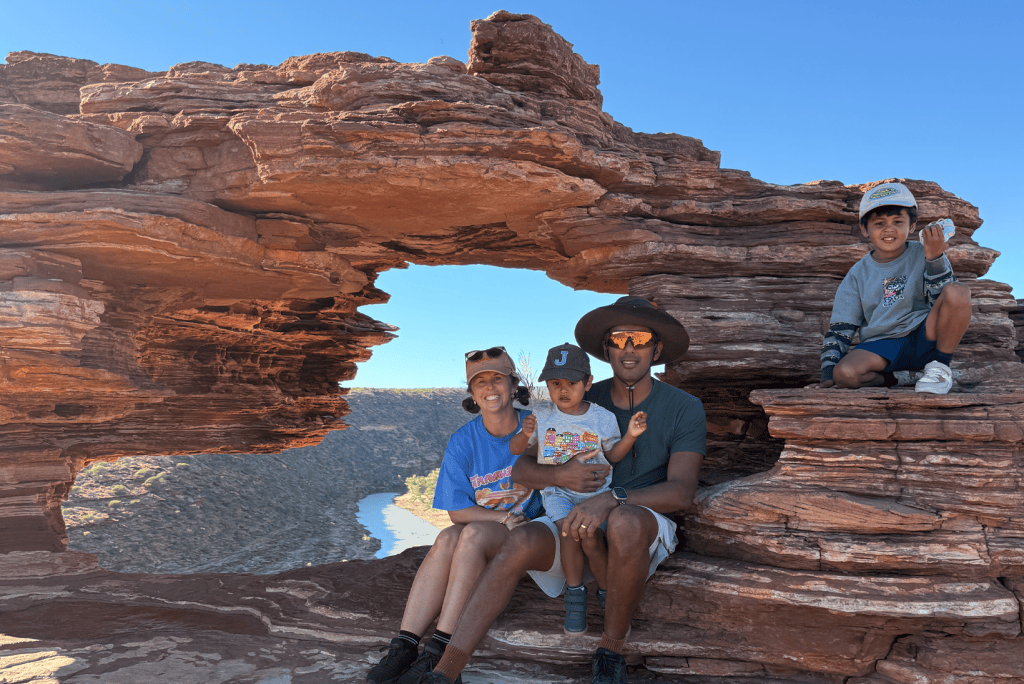
Equally significant have been the friendships.
Farmers, tradespeople and families from different backgrounds have become close friends with introductions seldom beginning with the question that so often opens a conversation in the city.
“One of the big highlights has been meeting different types of people that I would never have met at home and never been friends with at home,” Tristan acknowledged.
“You actually don’t even say what you do for work. Whereas back at home you’d meet someone and that would tend to be one of the first questions you’d ask. You’re all here, spending time with your family and seeing the country. It’s just brought down to its basics.”
The contrast has made Tristan more conscious of the calculations that can accompany a professional introduction: whether someone might become a customer, help with a role or provide a useful connection.
“How can this person help me? Or can I sell to this person? Or is there any benefit in me having this conversation?” he recalled.
“But on the road, I’ve enjoyed getting to know people without those questions. I didn’t realise that was what it was until I started this. There is a very big difference in how you introduce yourself, who you hang out with.”
In terms of preparation, Ainsley took care of the planning, with the route shaped largely by the seasons and a ‘follow the sun’ philosophy. The family headed north during winter and south during summer, making room for visits from relatives, major destinations and changes along the way.
As the designated driver – not trip planner – Tristan is often happy to discover what is coming next.
“I get told which direction we’re driving and where we’re going,” he said. “I’ll be like, ‘I just saw this thing pop up on Instagram. This looks really cool.’ Ainsley’s like, ‘Yeah, we’re going there in four days.’”
Having time has allowed them to stay longer in places they enjoy. It has also taught them the value of leaving a day empty.
“When you pack up and set up, it takes half a day then you’re travelling a couple of hours,” Tristan said.
“You get quite exhausted. If you’re staying four days somewhere, schedule day three to be a rest day. We’re doing nothing. We’re just staying at camp, the kids are going to ride their bikes, we’ll do a cook-up of something and just chill out.”
The children have needed that pause as much as their parents. Hugo is now five and Jude – who is now three – has spent more time living in the caravan than in the family home.
“He doesn’t remember the house,” Tristan said.
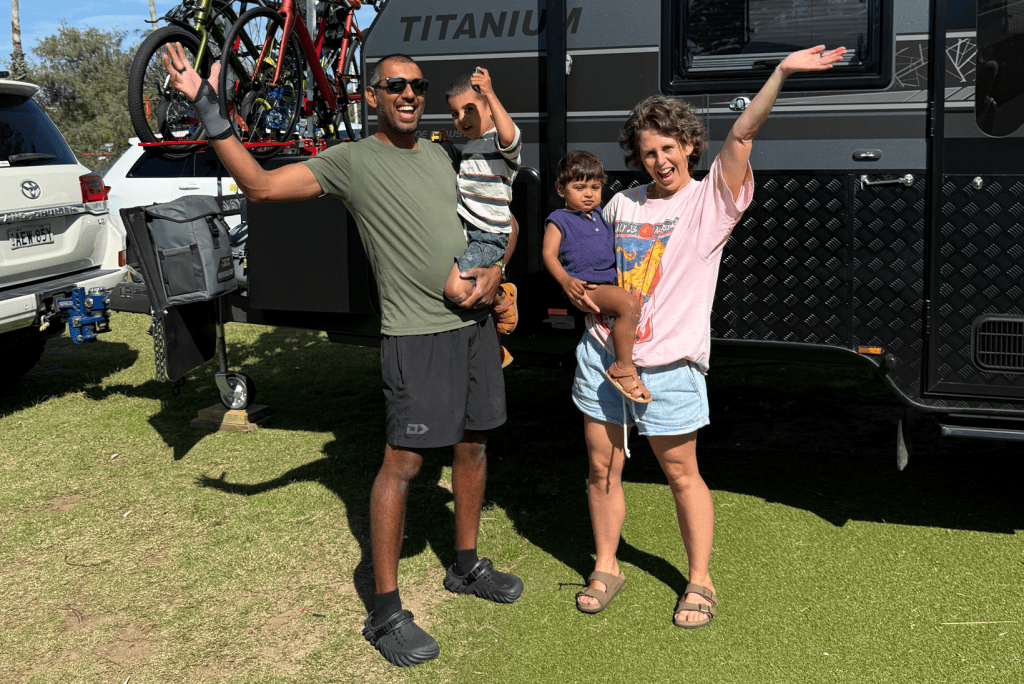
Living together has brought the family extraordinary experiences, but it has also tested their patience.
“The 24/7 parenting, that’s tough,” he said. “There’s no space, even in your relationship with your wife or with the kids. You’re on top of each other.”
There is no commute, workday or separate routine to create a break. Even an enjoyable day can leave both parents exhausted.
For Tristan, running has provided a consistent outlet. He set a rule at the beginning: whenever they stayed somewhere for two nights or more, he would go for a run.
“That’s kept me sane,” he said. “I’ll go for my run, I’ll get to listen to my podcast, I just get away from everything and I’ll go quite early.”
At the point of this interview, he had completed approximately 147 runs, many at sunrise, through stations, along beaches and across red dirt.
“It’s been a really, really nice fitness goal to have,” he said. “To get away and come back refreshed and know that I’ve had my time.”
Finding that time has been harder for Ainsley, however. She has tried to establish a Pilates routine, but there is not always a suitable private space – plus, the boys also tend to seek her attention more often.
“Her outlet’s been stripped away a little bit,” Tristan said. “We try very hard to give her space to be able to do that.”
Those realities are part of why the family will eventually stop travelling, alongside the need to earn money again. Tristan remains enthusiastic about the experience, while acknowledging what it asks of them.
“At the end of every day, regardless of if we’re with friends or not, we’re shattered,” he said. “Absolutely exhausted, more so than if we were working.”
Tristan misses work for reasons that extend beyond the role itself.
“I loved being able to take a customer out to golf,” he said. “I had that opportunity to get a lot of social outlet through work. I loved a lot of my customers and I consider them friends, a lot of my colleagues I also consider friends. So I enjoyed going into work and being able to do that.”
Ahead of a planned December return, he has begun applying for jobs – notably through Seek and LinkedIn, rather than conversations through his network at this stage. One task is proving particularly unfamiliar, however.
“I haven’t had an interview for 15-16 years,” Tristan said.
“Every job and promotion that I’ve gotten has been with a manager that knows me inside out. I’ve never had to pitch. I’ve never had to sell myself for a role. So that’s completely foreign to me.”
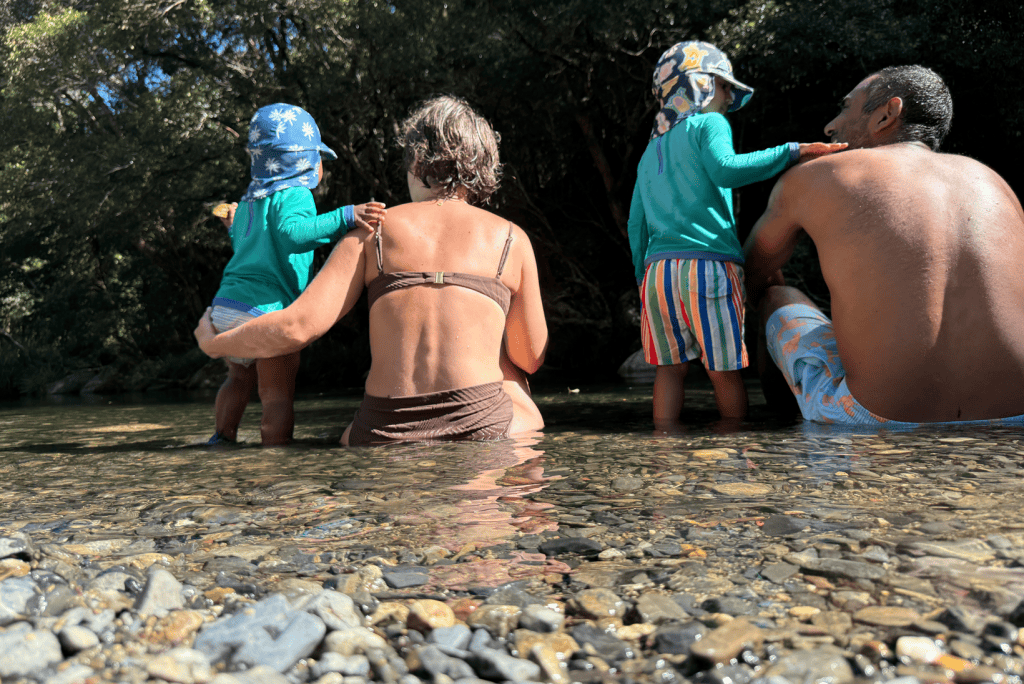
Tristan can also understand how prospective employers might interpret his time away. Some may see someone refreshed and ready to return while others may question his experience outside HPE or his absence during a period of rapid change in AI.
“I hope the industry view this as, ‘this guy is back and he’s refreshed’,” he said.
“Ultimately, if you know how to sell and you know how to lead and you’ve got a decent reputation of doing it, then you’re going to find a job.”
Tristan’s confidence rests on the relationships and experience that he built before leaving.
A vendor role is his preference, ideally in sales leadership. His channel network is an asset he also wants to put to use. Likewise, he would be particularly interested in helping a newer company establish itself in Australia.
“That needs someone that has a big channel network, that knows how to do sales leadership, that knows how to carry a bag as well,” he said. “You need to do everything when you’re starting up. I feel like I would be really good for that.”
Tristan knows his family had financial circumstances that made stopping work possible. He also knows that other families have found ways to travel while continuing to earn.
“Starlink has made such a big difference,” he said. “The amount of families that we see working on the road.”
Some work a few days a week. Others start early, complete several hours and then spend the day with their children. Tristan and Ainsley deliberately chose to take the full break.
“I wanted to be all in,” he said.
When asked what he would tell someone considering a similar trip, his answer is straightforward.
“Can it be as simple as just do it?” he said.
“Work will always be there when you get back. The industry will be there when you get back. I could find every excuse under the sun to not do it.”
But Tristan is looking forward to returning to an industry he still enjoys. Equally, he is also glad he acted when the opportunity was there.
“You’ll be able to do all the things that you did,” Tristan said. “But you’ll have two years that will arguably be the best two years of your life. No matter what, you will always have that in your back pocket.”
Inform your opinion with executive guidance, in-depth analysis and business commentary.

