
Home
You’re currently viewing our content for All Regions.
You can switch to a different region:
August 20, 2026
“We built it… all 100% of it, internally. It cost more than $200,000 to develop and most people thought it was a terrible decision.”
Most businesses outsource the creation of a new company website – commissioning an external agency is the obvious choice. Often faster, usually simpler and considerably cheaper.
Not Adam Centorrino.
“Everyone said the same thing – ‘What the heck? There are so many website companies who you could go and pay $40,000 to build it’ – they all thought we were crazy,” Adam recalled.
Most companies – especially managed service providers (MSPs) – delegate the capabilities that don’t directly generate revenue. Don’t waste time on things that don’t bring in the dollars.
As Founder and CEO of Centorrino Technologies (CT), Adam has spent 20 years doing the exact opposite.
“Yes, we could have hired an agency for a fraction of that but my thinking was different,” Adam explained.
“We would have spent months teaching an agency who we are. Explaining our culture, our values, our tone, our brand, what colours to use, what we don’t stand for etc. Instead, we hired those capabilities internally.
“The same team that built our website almost three years ago is still maintaining it today. They understand CT because they are CT.”
This isn’t a story about a website, however.
Adam is playing his own game, by his own rules, with his own philosophy. Anchored in the belief that the capabilities that define a business should belong to the business.
“I know this approach costs more, at least in the short-term,” Adam accepted.
“But that’s the benefit of being the only shareholder in the company. I don’t have to go and convince a whole team of people to spend the money.
“That means if we’re going to do something, let’s do it properly and so what if it costs more? I’ll never have to think about it again because we’ll get it right the first time.”
If any project of work contributes to customer experience, competitive advantage or long-term growth, Adam’s instinct is to build it internally, own it and improve it over time.
The website simply happens to be the most visible example of long-term thinking in a market where speed often wins the argument.
But speed seldom equals success.
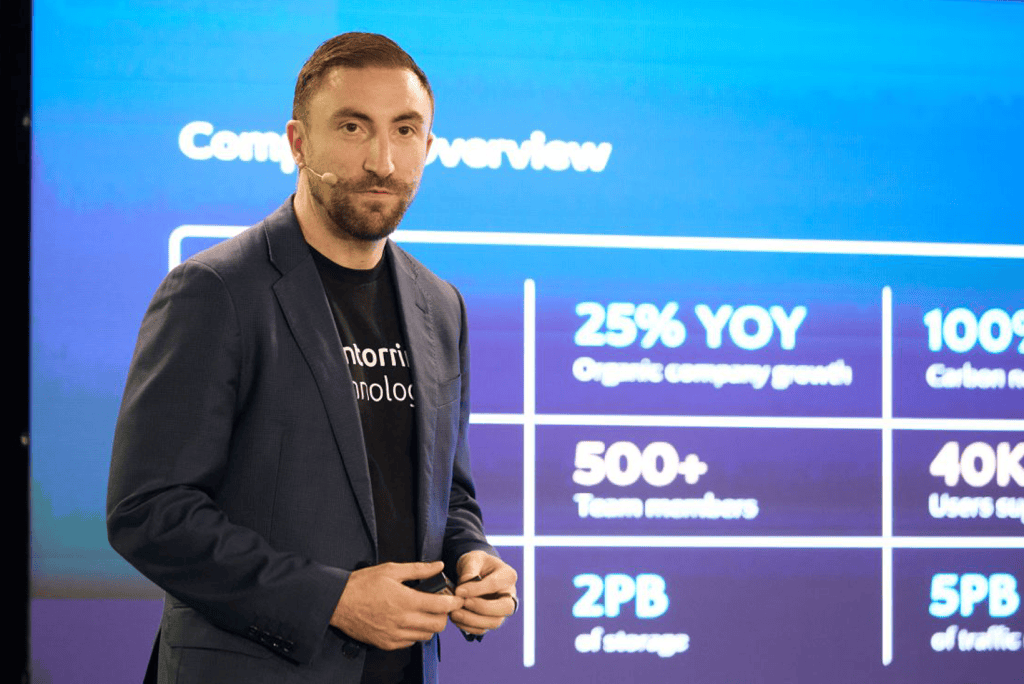
This philosophy has quietly shaped one of Australia’s fastest-growing MSPs – evident by the recording of organic growth of 41%, 39% and 45% across successive years, followed by more than 25% in FY26.
“I honestly don’t spend much time worrying about what everyone else is doing in market,” Adam shared. “I’m focused on achieving the best possible outcome for CT.”
The achievement of consistent double-digit growth – which is no easy feat given such tough economic conditions – demonstrates more about how the business thinks, rather than simply what it has achieved.
On paper, the past 12 months tell a transformational tale for the Melbourne-based business – which was founded in 2006.
Three acquisitions in Centauri, DQA and Cloudstreet – the latter offering a foothold in Darwin as the final state or territory to have boots-on-the-ground presence in Australia. Plus, new technical capabilities moving up the application stack in Microsoft Dynamics 365.
From the outside, it would be easy to conclude that CT has suddenly became an acquisition-led business.
Adam smiled at the suggestion.
“We didn’t wake up one day and decide we wanted to acquire businesses,” he qualified.
“It was a very deliberate process. We first identified the capabilities that we wanted to bring into CT. From there, we built the capability internally to execute acquisitions properly.”
That order is important.
Most MSPs identify a business they want to buy – or usually, one that becomes available – and then work backwards to justify it. Opportunism is rife in the M&A market today.
As always, Adam started somewhere else entirely.
“We have our own M&A advisers working within the business,” he explained.
“They understand our company first – our culture, our values, what we’re looking for and what success looks like. Once they understand us, they can go out and identify businesses that genuinely fit.”
Supporting this function is an in-house legal capability sitting alongside an internal integration team that manages every acquisition.
In other words, everyone involved is part of CT. They understand the culture, the philosophy and the way the company operates because they live it every day.
Once again anchored in the belief that the capabilities that define a business should belong to the business.
“I’ve heard plenty of horror stories about acquisitions failing,” Adam shared.
“Businesses overpay, cultures clash, integration becomes difficult and money gets lost. So my thinking was simple – let’s stack the odds in our favour.
“Yes, building this capability internally costs more upfront. But if it significantly reduces the number of failed acquisitions, then it’s absolutely worth the investment.”
Many MSPs use external M&A advisers because, on the surface, it’s cheaper. In many ways it’s akin to outsourcing marketing.
“But I needed people who genuinely understood our business,” Adam confirmed.
“I wanted people who could accurately represent who we are and properly assess whether another business was the right cultural fit. Otherwise I’d have to personally analyse every acquisition opportunity myself, and that’s simply not realistic.”
For Adam, the logic checks out given the business continues to grow at pace with customer attention remaining the daily priority.
No doubt the industry double-backed when the job advertisements first surfaced, however.
“Why on earth is CT hiring investment analysts and M&A specialists?” Adam laughed.
“But when I looked at private equity firms, I noticed something. They’re exceptionally good at buying businesses. Why? Because they have specialist people working inside their own organisations.
“Those people understand exactly what the firm is looking for. Their loyalty is entirely to the organisation they work for. I wanted exactly the same thing.”
Hence a desire to have an in-house M&A team with complete allegiance to CT – not to transaction fees or external commercial incentives.
The mandate? Simply find the right businesses to buy.
“The people we’ve hired have come from industry, private equity and investment backgrounds,” Adam continued.
“They know how to structure transactions. But they also bring the CT philosophy to every deal because we’re very passionate about not approaching acquisitions like private equity.
“We don’t want to be seen as shark-like bankers buying businesses. We want to approach acquisitions in a far more human, culture-centric way.”
In looking back on three acquisitions in quick succession, Adam can already see a return on in-house investment.
From day one, every acquired business is integrated into the company environment – using company systems, company platforms, company tooling.
Everything is immediately standardised.
“I’m an engineer, actually, let me rephrase that, I’m an ADHD engineer,” Adam confessed.
“The idea of technical debt everywhere would be an absolute nightmare for me. Yes, it costs more and sometimes we’ve acquired businesses where employees received new laptops only seven months earlier.
“But I’d rather absorb that cost than place additional pressure on our internal IT teams by supporting multiple environments, multiple standards and multiple device fleets. I’d rather complete the integration properly on day one which is also best for our culture.”
There’s that philosophy again. Build it properly once to prioritise long-term benefit.
Decision making within the corridors of CT is an anchored on focus – a focus on the objective but perhaps more importantly, a focus on capability. When translated into a crowded MSP market, that means stay in your lane and learn to say no.
“For me, the key has always been to do what you do exceptionally well and stay focused,” Adam explained.
“You simply can’t be everything to everyone. We don’t target every customer segment and we don’t target every industry vertical. We have our niches, we stay within those niches and we go incredibly deep.”
At the core, the business prioritises four core verticals in:
“One thing I see a lot of MSPs doing is saying they work across construction, healthcare, education, manufacturing and every other industry,” Adam questioned. “My question is always: how? More often than not they’ve simply got one customer in each industry.”
In most instances, a MSP runs a customer profile check via the CRM, notices a couple of schools on the books and suddenly, imagines an education specialisation.
“That’s exactly right,” Adam acknowledged.
“For us, if we’re going to say we’re in a vertical, we ask whether we have at least around 15% of that market. If we don’t, then we don’t consider ourselves genuinely established in that vertical and we know there’s still white space.
“We’ve deliberately selected a handful of industries we want to dominate, and equally importantly, we’ve deliberately chosen industries we won’t pursue. One of the interesting things is that many of the organisations people assume are our competitors rarely compete with us at all because we’re simply operating in different sectors.”
For CT, only true differentiation can be achieved in the weeds, down in the very depths of an industry sector. On the ocean bed, where the sun doesn’t shine and only the strongest survive.
“100% because each of our core sectors are highly specialised,” Adam continued.
“Take defence and intelligence, think about the credentials you need just to enter the market? We now have more than 200 security-cleared staff but those capabilities weren’t built overnight, they’re the result of long-term investment.”
Take education as another example. The business employees former teachers, former deputy principals and former leaders in learning to speak the same language as customers.
That is what vertical specialisation means.
“Manufacturing is a good example of the opposite,” Adam outlined. “We’re not manufacturing specialists, so we don’t claim to be. It’s simply not a market we’ve chosen to focus on.”
But how can an MSP in a competitive industry not only survive but thrive – remember, organic growth of 41%, 39%, 45% and 25% – by excluding such a vast segment of the Australian market?
No CEO walks away from deals. No CEO leaves money on the table.
“Very rarely do we even find ourselves in that position because we aren’t pursuing those opportunities,” Adam qualified.
“Our website clearly lists the industries we specialise in. If a prospective customer visits our website and doesn’t see their industry represented, they generally conclude we’re probably not the right fit.
“We’ve deliberately aligned our messaging, our positioning and our lead generation around the industries we want to serve.”
Many MSPs purchase expertise when they need it but – in line with long-term thinking – CT builds it before customers ask for it. Capability becomes embedded inside the business itself. Not borrowed from outside.
“Exactly, many of our customers have Microsoft-first strategies which is why Dynamics became a natural extension for us,” Adam explained.
“We weren’t entering a new technology stack for a completely different customer base. We were staying with customers we already understood and simply taking another capability into those relationships.”
Regardless of the company size, industry sector or technology solution however, CT is guided by a simple North Star philosophy that shapes all customer engagement – “just remove friction.”
“Customers increasingly want a single partner to manage everything,” Adam added.
“Dynamics itself is only part of the picture because it feeds into Dataverse, Power Platform, Power Apps and the broader Microsoft ecosystem. And customers want us to manage those environments as well.
“Instead, we were having to say that ‘we’ll manage everything here, but you’ll need another provider for this part.’ That created unnecessary friction so our strategy became very simple. Let’s remove that friction by bringing those capabilities into CT.”
Most growth stories revolve around saying yes while Adam’s has been built on saying no. Not because the opportunities weren’t attractive but because they distracted from building genuine expertise.
Historically, CT forged its reputation around infrastructure and managed services – seldom, if ever, did they venture up into the application stack.
Acquisition wasn’t about capturing another revenue stream. It wasn’t about following a market trend. It wasn’t even about Dynamics itself.
It was about making life simpler for customers. Only then did the conversation turn to acquisitions.
“Trying to build a Dynamics play would just take us for a very long time,” Adam acknowledged. “So acquiring that talent in was key.”
It’s a subtle distinction because acquisition wasn’t the strategy, removing customer friction was.
And once again, the same philosophy quietly reappears. When a capability matters enough to define the customer experience, Adam would rather own it than outsource it.
That instinct has shaped almost every major decision the company has made over the past two decades.
Spend enough time with Adam and one thing becomes increasingly apparent. He rarely talks about size.
Not because growth isn’t important, rather he doesn’t believe it’s the thing worth obsessing over.
As CT kick-starts another year of expansion in FY27, the targets are certainly ambitious. The company expects another year of around 22% growth, supported by further acquisitions while continuing to invest organically.
Yet headline growth numbers rarely tell the whole story.
“There are certainly economic challenges all around, so it’s not without its own challenges,” Adam acknowledged.
“We face headwinds as well. And that’s the big thing when it comes to these organic growth numbers. Obviously there is some churn… like many other partners have had customers go into receivership. So you need to not only grow by that 22%, but you have to backfill what you’ve potentially lost.”
It’s a practical reminder that growth isn’t simply about winning new business. It starts with protecting what you’ve already earned.
That same realism shapes the way CT plans for the future. While many MSPs treat the beginning of a financial year as the starting point, Adam believes the work begins long before the calendar changes.
“The one thing that I notice about a lot of people when they plan the future years, they almost take no consideration into the run-up they’ve already had,” he explained.
“From our perspective, we start working on FY27… seven or eight months out. The contracts you’re signing in May or June of FY26 have only billed two months in FY26. They’re going to bill the bulk of it in FY27.
“So you need to really start planning for FY27 months and months in advance. And start winning those customers that you know are going to go live on 1 July.”
Perhaps it sounds obvious. But it’s another example of Adam refusing to think in financial-year increments.
The business operates as one continuous rhythm rather than a series of annual resets. That philosophy becomes even more important given the industries CT serves.
“Government…” he smiled. “When have you ever known government to buy something quickly? Our contracting times are enormous. Our sales cycles are enormous because of the nature of the verticals we operate in. You can’t leave it to the last minute.”
Again, patience becomes a competitive advantage.
For much of its history, CT was almost entirely Victorian. In fact, right up until 2020, when COVID-19 hit, the business was 100% located in Melbourne.
The pandemic changed that trajectory, however. It was no longer viable to be a one-city, one-state kind of player.
Today the MSP operates nationally, with Darwin completing its presence across every Australian state and territory – through the purchase of Cloudstreet – while New Zealand has become the next strategic frontier. But Adam is careful not to confuse geographic expansion with simply replicating Melbourne everywhere else.
“The important thing for me has always been that we should be very humble in approaching these cities,” he noted. “And not go in like, ‘we’re a Melbourne company, so our way is the right way.’ We need to enter a market very slowly and we need to understand how that market works.
“The dynamics. Some of the markets in which we operate are very relationship driven while others are a bit more cut-throat and cost based. And that’s really systemic of the culture in that particular state or territory.”
It’s an insight that many growing businesses overlook. National expansion isn’t simply opening another office but learning an entirely different market.
Adam points to Canberra as an example. The company initially entered organically and success followed – just not quickly enough.
“The team there had done a fantastic job but the acquisition of DQA really propelled us forward,” he noted.
“By contrast, NSW has evolved differently. The organic approach has worked and done really well. Different markets are absolutely different but it’s important that we don’t just go and overlay our thinking and our philosophy.”
That humility extends inside the organisation too. One phrase, in particular, has always bothered him.
Head office.
“Ahh yes, I never wanted us to be a business where people talk about ‘head office’,” Adam dismissed.
“Instead, I spend much of my time travelling between locations, making sure every office feels connected to the same culture. I’m certainly on planes a lot more today than I have ever been but it’s important that I keep visiting each of our offices. I’m there for the team as much as I’m there for customers.”
As CT has grown to more than 530 employees, maintaining culture has inevitably become harder. But the effort remains deeply personal.
Adam still tries and remembers everyone’s names and still personally congratulates each team member on company anniversaries. There is no romanticism in continually harnessing and fostering that culture, just discipline.
For example, anything that resembles unnecessary bureaucracy immediately raises suspicion.
“Anything that smells of corporate or anything that smells of red tape, I’m just not interested,” Adam clarified. “We are very much a flat structure.”
The same thinking appears again when discussing customers.
Although the company increasingly serves larger enterprise and government organisations, Adam remains determined not to abandon the smaller businesses that helped build CT in its early years.
“The customers that got us to where we are today shouldn’t be dumped just because we’re now too big for them,” Adam challenged.
Instead, the MSP created a dedicated SMB division, allowing enterprise teams and smaller customer teams to evolve independently without compromising either experience.
“The different types of customers really do need different focus,” Adam expanded. “Different attention and different ways of serving them.”
By segmenting those teams, the company isn’t creating distance, it’s creating relevance. That approach ultimately comes back to one deceptively simple principle – every single customer must feel like the most important.
“Whether you’re a 10-man band that I used to serve when I was a teenager operating out of my parents’ house or whether you’re a very large federal government agency – that statement needs to be true,” Adam confirmed.
It’s one of the clearest expressions of CT culture. Growth may change the scale but it should never change the experience.
As founder and sole shareholder of the business, Adam is in a unique position. His guiding principle is not freedom but transparency – a value that plays out on a daily basis.
“To some extent it’s to my detriment,” he acknowledged.
“But I am a very transparent person. My leadership team and a lot of the managers that we have in our business know the plans, know what we’re doing, what we’re trying to achieve. I will approach them for advice because the one differential between me and all of them is that they’ve all worked somewhere else.
“They have experience. I’ve never worked anywhere else. I’ve only got CT context. So, I love hearing their feedback and I love hearing their ideas.”
“I know a CEO wouldn’t normally go to other people to crowdsource ideas. But that’s the normal CT way.”
In many organisations, leadership is demonstrated by certainty. Here, it seems to be demonstrated by curiosity.
“My team frequently tell me that I’m the worst compliment giver,” Adam smiled.
“I very rarely look back and go, ‘wow, look what we’ve achieved.’ I focus on what we need to improve and how we can be better tomorrow than we were today. That’s absolutely a failing on my part. I’d love to be better at that.”
It’s a revealing admission. Most founders would instinctively celebrate 20 years of business while Adam is already thinking about tomorrow morning.
Maybe, just maybe, that’s why the story of CT feels different from so many growth stories.
The acquisitions are impressive. The national footprint is impressive. The growth is unquestionably impressive.
But none of those achievements appear to be the destination. They are the outcome of something much more deliberate.
No matter the topic, Adam repeatedly returns to the same idea, whether he’s talking about a website, an acquisition, customer relationships, leadership or culture.
The growth, he believes, will follow. And based on the numbers, it’s difficult to conclude otherwise.
“Even today, I’m not thinking about whether we’re going to be a 1000 or 5000 people business,” Adam admitted. “That’s just not in my thought process. How do we still have the customers tomorrow? How do we keep our humility as we grow?”
Then comes the sentence that quietly ties together 20 years of building CT.
“Just focus on those fundamentals and the rest just kind of works itself out.”
Inform your opinion with executive guidance, in-depth analysis and business commentary.

