
Home
You’re currently viewing our content for All Regions.
You can switch to a different region:
May 12, 2026
“My wife tells me that I don’t know what I think until I hear myself – there is literally no internal one-on-one, it’s all external.”
The morning sun is breaking out over Iron Cove and Robbie Upcroft is stretching at his go-to bench – the unofficial start line for the Bay Run.
Running a 7km circuit around Sydney’s Inner West at 7am is the setting for a conversation in which communication is the common thread. This is an interview at pace.
“Be warned, I’ll be talking all of the way around this loop – the whole way around,” Robbie smiled.
“I process the world through conversation and discussion. There doesn’t even have to be another person there for me to have a conversation. I’ll literally talk myself through things.”

Communication is everything to Robbie – speaking as Country General Manager of Australia and New Zealand (A/NZ) at Tech Data.
The reason he’s been hired and on one occasion, fired. The reason he’s been praised and criticised. The reason he’s been followed and ignored.
“The key to communication is not what you’re saying, it’s how people are hearing it,” Robbie noted.
“And if people aren’t hearing it properly, that’s on you. Which is why I’ve always tried to think carefully about how what I say, write or present is actually landing with the audience.”
That links directly to one of the most overlooked realities in communication. Too often, people focus purely on content while ignoring context.
Robbie is a leader who has been told:
“You’ve topped out” at Microsoft.
“You’re fired” at Webroot.
“You have two faces” at Insentra.
On each occasion, ample opportunity existed to lambast the direction of travel – the blame game was ready and waiting, it just needed a player.
Not Robbie, understanding context as well as content.
All three setbacks were down to his communication. His inability to articulate his value, inspire a team or create trust.
“Absolutely, you have to look inwards first – I 100% believe that,” he added.
After studying Journalism at Charles Sturt University, Robbie eventually headed down the PR and Communications path instead. But perhaps it’s the former that resonated most, given such refreshing honesty about a career of highs and lows.
It’s not rare, it’s unheard of that a sitting CEO would be so open about mistakes made of this type of personal nature.
Nobody ‘tops out’, they seek new pastures. Nobody gets ‘fired’, they leave by mutual agreement. Nobody has ‘two faces’, they’re authentic to a fault.
Or so the story always goes. Words with no meaning.
In sharing the story of Robbie – a proud product of the Central Coast – it’s important to start at the start. Despite graduating into the worst recession since the Great Depression, job offers were dependable albeit different.
“Those three job offers tell you everything you need to know about how I think,” Robbie explained.
First up, the Foreign Service, as an ambassador via the cadet program. Second was Westpac and the chance to become a banker. Then the third, a publicity officer at a children’s book publisher.
“Which job do you think I took?” Robbie laughed.
Armed by advice from his dearly departed mother, Robbie ‘followed his heart’ and opted for the least stable but most fulfilling role.
Logic was still attached to the decision, however.
Becoming a diplomat would entail domestic and international travel, meaning lots of time away from his now-wife Linda, who he met on the first day of university. Plus, favouring words over numbers ruled out banking – especially during ‘the recession that Australia had to have’.
“I was grateful to have the offers in the middle of a recession but landing on something that genuinely spoke to my heart was fantastic,” Robbie said.
Each week, the fledgling wordsmith would read up to 50 to 100 children’s books and write the blurbs for the back covers, as well as the press releases and all promotional material.
“It was lovely and I’ve still got so many of the books because we got to read them to my son, Toby, when he was a kid,” Robbie added.
The role finished after 12 months so job interviews resumed with no regrets of turning down a rock solid diplomatic post or banking position as the economy started to the improve.
Enter Castle Computers in the mid-90s, which was acquired by catalogue reseller, MicroWarehouse.
As marketing manager, Robbie was tasked with running four versions of the catalogue at the same time – one in market, one being produced, one being planned, one being sold. It was his own publishing house for personal computer products, offering insight into the art and science of printing processes.
Joining Tech Pacific in early 1998 – a distributor which would be acquired by Ingram Micro in 2004 – represented a first major move in the market. The first true introduction to the full-throttle world of distribution.
“Back then it was all warehouses and banks – stack them high, sell them low,” Robbie recalled.
“It was all about stock turns, credit, cash flow and inventory. Honestly, and I still say this to people today, if you want a career in IT then spend some time at a distributor because that is where you learn how the entire industry actually works.”

At the time, product marketing managers operated as mini general managers housing a wide spectrum of skills including commercial knowledge, sales capabilities, marketing expertise, financial acumen and operational awareness. All in play at once, managing stock turns, margins, partner relationships and credit.
“I loved it but then I got the opportunity to join Microsoft in 2000,” Robbie continued.
“Microsoft was fascinating at that time because this was an incredibly dominant era of Windows and Office being at the peak of their market power. But Microsoft wasn’t the Microsoft of today thinking ‘we win together’ – this was very much a ‘Microsoft wins’ era and internally, you could see the limitations of that dominance.”
Such an ‘incredible learning environment’ spanned 11 years across Sydney and London, starting with a 26-year-old communications major suddenly managing multi-million-dollar budgets attached to large targets.
“I always compare that period to white-water rafting,” Robbie explained.
“The river was already moving at incredible speed. You weren’t controlling the river, you were steering within it because at Microsoft, 95% of the product and brand work was already done globally. Locally, our role was the last mile.”
That anchored on connecting the offer to real customers, finding alliance partners, positioning the value proposition for different segments. In other words, communication was critical.
“One of our standout campaigns was a regional roadshow with Australia Post, MYOB and Chartered Accountants – we hired the old tour bus of Robbie Williams and drove through regional Australia,” Robbie shared.
“That really opened my eyes because it stopped being about Microsoft and became about helping a small accountant in Bendigo run their business better through technology.”
That came with the realisation that customer-facing roles that involved strategy beyond pure marketing execution was the path forward, kick-starting a pivot into sales and leadership.
“That’s when I realised that marketing alone wasn’t a pathway to the executive table,” Robbie acknowledged. “That was certainly the case back then and before marketing became as commercially central as it is today.”
An MBA in Business Administration and Management soon followed at UNSW Business School to sharpen those commercial skills. Preceding this was a relocation to the UK for more than two years, before returning to Australia just as the Global Financial Crisis (GFC) was playing out.
In parallel, the market was changing with the emergence of Amazon Web Services (AWS), a growing Google and VMware reshaping infrastructure. From 2008 onwards, the industry was being turned inside out and upside down.
“Microsoft knew it had missed major shifts in search, mobile and virtualisation because it was still trying to view everything through a Windows-centric lens,” Robbie observed.
By 2011, Robbie had also run out of road at Microsoft.
After applying for an internal role – with more than a decade of experience across two continents under his belt – the response from his manager sidelined any thoughts of progression.
“We don’t really see a future for you beyond where you are now.”
For the avoidance of doubt. You’ve topped out.
“That was a huge moment for me,” Robbie admitted.
“And to this day I still think about it from a management perspective. I asked myself at the time, what am I not communicating properly about my own ambitions and capabilities? But I also realised that I didn’t want to work for someone who viewed people that way and interestingly, two senior people also resigned on the same day after receiving similar feedback.”
One of the hardest things in any role is articulating your own value. Not because the value is not there but because the people closest to the work often assume everyone can already see it.
They cannot.
In most organisations, visibility and value are not always the same thing. Quietly solving problems, protecting relationships, holding teams together or driving momentum behind the scenes can easily become invisible if nobody connects the dots.
And if you do not define your contribution, somebody else eventually will – often in far simpler terms than the reality.
“I genuinely believed that I was capable of more but I wasn’t communicating that effectively so that part is on me,” Robbie clarified.
“I have strong self-belief but realistic self-belief and my option at the time was to either stay frustrated and blame everyone but myself, or go and test myself elsewhere. Ultimately that became one of the best decisions that I ever made.”
Moving to McAfee to run the development and delivery of SMB, distribution and channel partner strategies across Asia Pacific represented new responsibilities and new territories in the expanding world of cyber security.
Singapore every other week, then India, Thailand and Indonesia as a first major regional leadership role ramped up. But without the power of a Microsoft badge, doors didn’t open as frequently or quickly – especially in a hyper-competitive and hyper-crowded market housing thousands of vendors.
“Leaving Microsoft was incredibly important because staying too long in a large vendor can absolutely silo your thinking,” Robbie said. “I wanted to move from simply executing strategy to actually writing strategy.”
The people who stay relevant in business are seldom the ones who think they’ve arrived. They’re the ones who keep developing long after everyone else becomes comfortable.
A development plan is not just a HR exercise or performance review template, however. At its best, it’s a commitment to staying adaptable in an environment that never stands still.
That is why self-improvement matters. Not from a place of insecurity but from an understanding that growth compounds over time.
Small improvements in communication, decision-making, emotional intelligence, commercial awareness or technical capability can completely change the trajectory of a career.
“If you’re not moving forward, you’re standing still – that applies physically, intellectually and professionally,” Robbie advised.
“One of the best books I ever read was Who Moved My Cheese? You should constantly be adding skills, adding perspectives and adding value. Whether it’s an MBA, AI training, or forcing yourself to do a ridiculous 50km trail run – growth only really happens outside your comfort zone.
“And I genuinely worry about people who spend 10 years doing exactly the same thing in exactly the same way. Because if that role disappears tomorrow due to AI or restructuring, what then?”
The strongest leaders are the most self-aware. They know strengthens, they know weaknesses and they know what to improve next.
They actively seek feedback instead of avoiding it. They remain curious instead of defensive.
In business, stagnation is rarely dramatic. It happens quietly. Skills become outdated. Thinking becomes rigid. Ambition becomes maintenance.
Robbie was appointed Managing Director across Asia Pacific at Webroot in March 2015, a 17-month tenure which represented a defining experience in his career.
“It absolutely was,” he shared. “Webroot was also the first and only time I’ve ever been sacked.”
This was a true turnaround story in every sense of the word, the vendor had lost major partners and distributors due to previous management and required a significant rebuild in market.
“I’m naturally a front-runner in business, I tend to embrace change rather than fear it,” Robbie added.
Within six months, nine people were hired and the business scaled up, down and up again as team dynamics were ironed out – from nine to three to 15 within the space of a year.
The message back to base was that this could be an X million-dollar business within a couple of years, the market potential was high and scale partnerships were in the works. Plans were progressing at pace.
“I was pushing hard,” Robbie said. “And honestly, I can absolutely acknowledge now that sometimes I run too fast and don’t bring everyone with me.”
Driving to work on the first day of the new fiscal year – pumped for what was ahead following a year of foundation laying and rebuilding – Robbie received a phone call. From HR.
The message was brutal.
Your contract has been terminated effective immediately. Don’t come into the office. Don’t access systems. You’ll receive a letter.
“Awful, absolutely awful – it completely blindsided me,” Robbie recalled. “I thought there was a lack of duty of care in the way they handled it.
“Firstly, you don’t do that to someone when they’re driving and secondly, I’d not had one negative word, feedback or performance review prior to this. They just said that I was pushing too hard and wasn’t the right fit for the role.”
One day you’re the face of the company – setting strategy, speaking to partners, shaking hands with customers, convincing employees to believe in a direction. The next, you’re gone.
What makes it especially harsh is the isolation. The higher the role, the fewer people tell you the truth.
“Getting sacked challenges your self worth and triggers a lot of soul searching,” Robbie reflected. “But I wouldn’t swap it for the world because it gave me a chance to really think about how I show up as a leader.
“What did that say about me? How was I turning up? How was I communicating? How was I bringing my team along for the journey?”
This was a classic case of moving too fast.
“That experience forced me to think deeply about how I communicate and how I lead,” Robbie added.
“I don’t berate people and I don’t have a negative view but I absolutely accept that I can run too fast sometimes and by the time I look over my shoulder, there’s nobody behind me. It also completely changed how I think managers should treat people.”
Battered, bruised but not broken, Robbie regained his composure and moved forward following an introduction to Ronnie Altit – CEO of Insentra – by Phil Goldie.
A role running national partnerships was vacant so Robbie joined Ronnie at Microsoft Australia Partner Conference on the Gold Coast for an interview in real-time. A week interacting with partners, sharing industry perspectives and understanding if a match existed.
At the end of the conference, during the gala dinner, Ronnie sat Robbie down and delivered his decision – ‘we’re not giving you the job’.
Gut punch.
“Then he said something I’ve never forgotten,” Robbie continued.
“You have two faces – a personal face and a workplace face. I want the personal one. He basically challenged me to stop building a professional facade and just be myself. And he was absolutely right. That feedback changed me.”
Back to communication again. After not articulating value at Microsoft or vision at Webroot.
“That was hard feedback to take after essentially interviewing for three days,” Robbie admitted.
“Ronnie said I could have easily walked and sulked at that point but I was open to feedback, took it on-board and made the change. I spent more than four years at Insentra – it was a fantastic experience and I still consider Ronnie as a good friend today.”
The role of leadership is ultimately cumulative. Every difficult conversation, wrong decision, breakthrough moment and personal sacrifice shapes how a CEO operates today.
The title may look powerful from the outside, but most effective leadership is built on lessons earned the hard way.
Robbie’s first act as a new leader at Tech Data – effective July 2025 – was a deeply personal town hall.
“I talked about Linda, I talked about Toby and I talked about family,” he said. “And I told everyone very clearly that family comes first because we’re not your family, we’re a business.
“I want people going to school recitals and I want them picking their kids up from daycare. Yes, there’ll be times where work requires extra effort but it has to work both ways. I’d rather someone work six productive happy hours than eight resentful ones.”
Bringing your full self to work is not about oversharing or performative authenticity, rather removing the exhausting gap between who you are professionally and who you are personally.
The people who create the most impact in business are rarely the ones hiding behind polished corporate masks. They are the people comfortable enough to think independently, speak honestly and operate with conviction.
“I expect you to prioritise the right things in your life – your family, your health, your relationship, your finances, all those type of things,” Robbie added. “And if you’ve got that sorted, then you’ll be a better employee at work.”
When people feel they can bring their real perspectives, backgrounds and personalities into a workplace, the quality of decision-making changes.
Conversations become less political and more honest. Teams challenge each other properly. Creativity improves because people stop spending energy managing perception and start focusing on contribution.
“Bring your full self to work,” Robbie advised. “Don’t build separate personal and professional identities because maintaining a facade every day is exhausting.
“I didn’t properly learn that lesson until my 40s but once I did, everything changed. The relationships got better. The leadership got better. The career accelerated.”
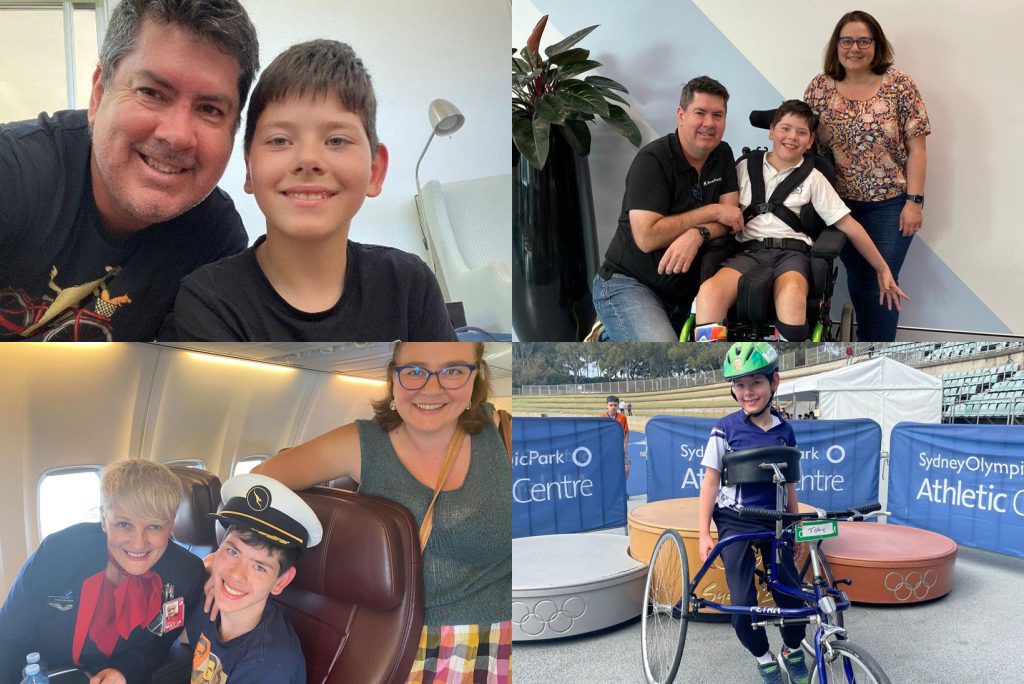
During that opening town hall, Robbie shared about Toby, his 13-year-old son who was diagnosed with cerebral palsy within the first 12 months. After missing some of the key early developmental milestones, the diagnosis came with a sense of relief as it helped frame the future for the family.
“Toby is our world,” he said.
“I can’t describe it because it’s all we’ve ever known but we move heaven and earth to ensure that he lives as normal a life as possible.”
In fact, Toby is a major factor in why Robbie has maintained a career within the technology industry.
“Technology has completely shaped what’s possible for Toby,” he continued. “He uses eye-tracking technology for schoolwork, coding, writing songs and even running a small business.
“Honestly, he’s one of the main reasons I stay passionate about technology. Because technology genuinely changes lives. And I think society – especially the tech industry – has become much more inclusive and accepting around accessibility and neurodiversity.”
In a mainstream school, Toby wants to either be an historian or architect when he is older – although the vocation changes on a daily basis. Whatever the career path, he will live a fulfilling life because of his support system of parents, family and society.
“The world is so much more accepting of kids with disabilities or accessibility issues,” Robbie outlined.
The case of Satya Nadella has also helped drive awareness and change, following the death of his son, Zain, at the age of 26 in 2022. Zain suffered from cerebral palsy and inspired the Microsoft CEO to use technology as a way of becoming more inclusive and accessible to users with disabilities.
“Technology is leading the way around accessibility and a lot of that traces back to Satya because of his own personal experiences,” Robbie added.
“Companies like Microsoft are leading the way on this through hiring policies which expand the candidate pool to people with neurodivergence because they look at problems differently which is great progress.”
Take Toby as a case in point. His memory, attention to detail and pattern recognition is out of this world because he has had to learn those skills from an early age.
“That’s absolutely an asset for him,” Robbie said.
As a family, Robbie supports Steptember and Cerebral Palsy Alliance among other charities, as well as Kids With Cancer Foundation Australia. Plus a host of children’s initiatives and literacy programs.
A leadership career is often described through outcomes – growth figures, contacts, acquisitions, share prices, awards. But the reality is usually a far messier story of momentum, pressure, setbacks and survival.
There are the obvious highs. But the lows cut deeper because they are carried publicly and personally at the same time.
With the 7km circuit ran and the coffee sipped, Robbie paused for a final moment of reflection.
“Honestly, my most proudest achievement is the people that I’ve mentored,” he summarised.
“Seeing younger people I’ve worked with go on to huge careers – that’s the most rewarding thing. Not the deals. Not the revenue. The people.”
Inform your opinion with executive guidance, in-depth analysis and business commentary.

