
Home
You’re currently viewing our content for All Regions.
You can switch to a different region:
February 24, 2026
“I was dumb. I had to ring my husband from St Kilda Road and say, ‘I can’t run, there’s something wrong with my Achilles’ – four weeks out from my first marathon.”
The industry term for it is ego running. Running to prove something, not to improve something.
But for Lisa Fortey, this wasn’t about beating the person next to her, the benchmark was never someone else’s Strava. Ego running is the product of beating yourself.
You tell yourself it’s discipline. Standards. Personal accountability. And in many ways, it is. Self-competition can be powerful. It sharpens focus. It demands effort. It keeps you honest.
At the extreme however, it can also turn quietly destructive.
“I would go for a long run every Sunday and try to beat my last time which is why I got injured,” shared Lisa, speaking as General Manager of Logicalis Australia.
“People would say that you don’t need to run a PB every weekend but I definitely did. I’m an incredibly competitive person but I’m more competitive with myself.”
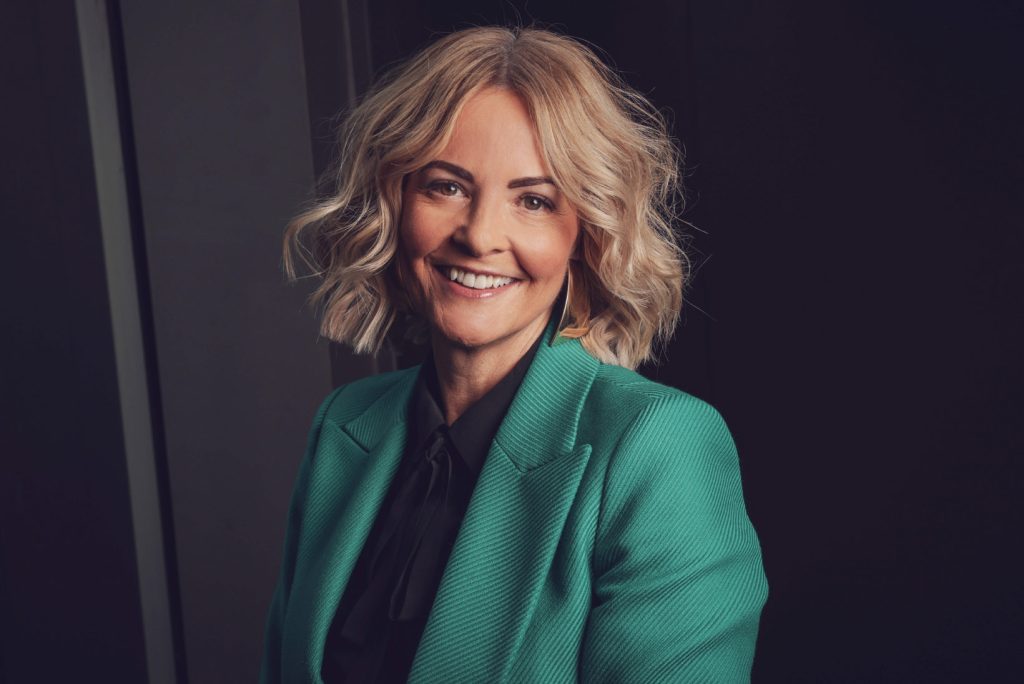
Training for a marathon best illustrated how formidable and fragile the self-competitive trait can be.
“My son, Henry, was about 14 months old at the time and I’d put on a bit of weight during pregnancy that I couldn’t get rid of,” Lisa recalled.
“My dad was running his 50th marathon at the time and suggested that I run my first alongside him – he paid for the entire family and we ended up doing the Honolulu Marathon.
“I came back from New Zealand and started training for my first marathon. I couldn’t finish running 3km so my friend suggested I join a running club and through fartlek training, I started finishing 10km.
“That was when my running coach suggested I go on long runs every Sunday.”
Up until this point, self-competition proved a powerful force.
Internal fuel that is quiet, relentless and self-directed – applause isn’t necessary, nor is comparison. You simply want to be better than you were yesterday.
But the same engine can burn too hot.
“With my Achilles, I remember my husband, George, advising me to tell the physio that I don’t care about running again, I just want to get through the marathon,” Lisa said.
“But I did care about running again. I was 34 at the time and I just hadn’t done any of the right stuff and required dry needling – blah, blah, blah. The Achilles is the hardest muscle to recover.”
Aspirations of running a 3:30 marathon evaporated.
“I finished in 4:09 but the last 36km were hell – I walked, ran, walked and ran,” Lisa added.
“It wasn’t what I wanted and I was actually seeing stars at the end. I took too much Nurofen and way too much Panadol during my run on an empty stomach – to this day I still can’t take Nurofen.”
There’s a particular kind of silence that hits when you realise you’re injured mid-marathon.
Not the noise of the crowd. Not the rhythm of shoes pounding concrete. A quieter, internal silence.
The pain is sharp at first. Then it becomes dull and persistent. You can’t turn it off. Every stride reminds you. You start calculating distance differently – not in splits but in survival.
Surrounded by thousands of runners, yet the experience is entirely yours.
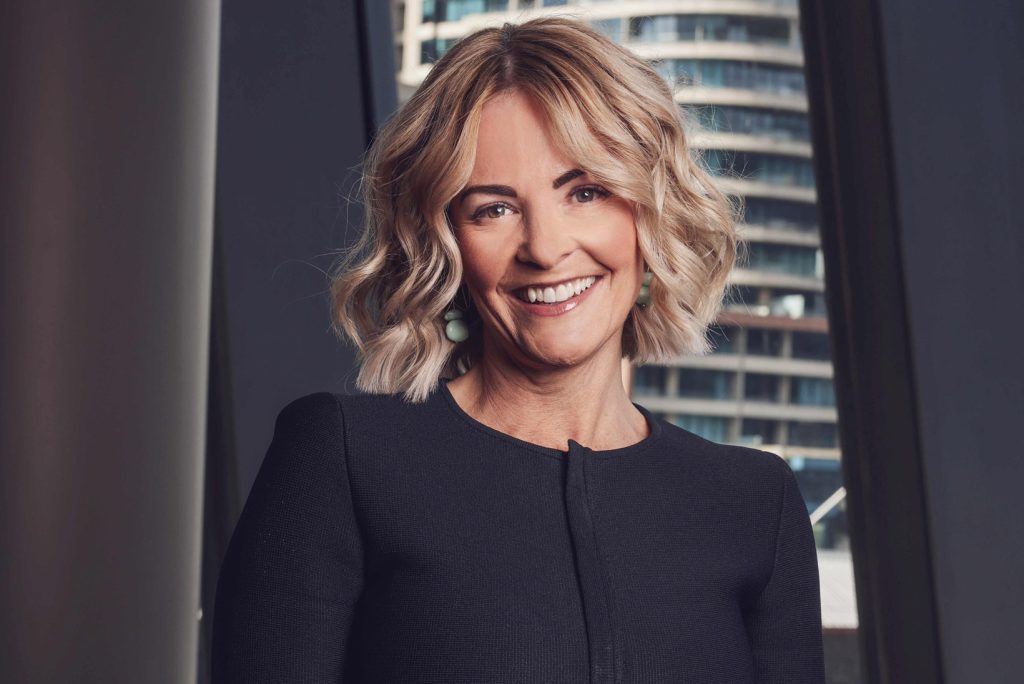
“No, I just have to get this done,” Lisa affirmed. “I have my kids and my family at the finish line – George was actually starting to get worried because he thought something had happened to me.
“That was my biggest fear. I had been away from home for three or four hours every Sunday training and I wasn’t going to let my family down. I had to finish it and I did finish it but the last 10km had nothing to do with fitness, it was pure mental strength.”
A full circle moment.
Competitiveness to take up marathon training post-pregnancy. Competitiveness to jeopardise fitness through over training. Competitiveness to push through to the finish line despite debilitating pain.
Formidable. Fragile. Formidable.
“I can’t let my competitiveness reach an extreme,” Lisa acknowledged. “I can’t let that little voice inside of me have too much influence which is why my husband is a very good leveller and my kids are a very good reality check.”
To repeat, the paradox is this – the trait that makes you formidable can also make you fragile.
Lisa’s story is a raw dance between both ends of the self-development spectrum – success when self-competitiveness is channelled, strife when self-competitiveness is commanding.
And the never-ending journey to becoming sustainably formidable. Learning to compete fiercely with your past self while forgiving yourself for not being perfect.
The strongest leaders, like Lisa, find a way to master both pressure and perspective.
Lisa held leadership roles in previous businesses before joining Logicalis, so the concept was not alien. Although the environment wasn’t conducive to strong executive development.
“Those businesses were quite different and were probably not paying to get the highest calibre of sales person,” Lisa added. “I was more of a psychologist than an actual leader, managing personal lives and troubles versus actually growing the business and being strategic about it.”
Equally, once at Logicalis, Lisa thrived as an individual contributor. Paid full-time with a full-time target, working four days a week and being in control of her own destiny was the ideal work-life set-up at the time.
“My customers knew I had my kids and on the day I wasn’t working, they could still call and my kids would be in the background,” Lisa recalled.
“I enjoyed that lifestyle and if I didn’t make commission, that was my fault. Then Sandra Tuohy – National Sales and Marketing Director of Logicalis at the time – kept pushing me to go into a leadership role.
“My response was always ‘I’m not doing it, I’m not doing it’ and then she finally convinced me. Then it was a case of, ‘damn, I wish I’d done it earlier’.”

Self-competition is often framed as a virtue but in this instance, it can quietly become a liability.
Highly self-competitive individuals measure themselves against an internal benchmark that is constantly moving – the goalposts shift the moment progress is made. In this mindset, ‘ready’ rarely arrives.
“I’m a bit of a control freak and I really talked myself out of it,” Lisa admitted. “I didn’t feel like I had all of the skills to be successful as a leader but in hindsight, there’s never a right time and I don’t think you can ever have all the skills.”
But there is always another skill to refine, another weakness to fix, another milestone to hit before stepping forward. Leadership roles, however, rarely demand perfection – they demand momentum.
Such internal pressure can create yet another paradox – the very people who hold themselves to the highest standards hesitate the longest. They see gaps others don’t. They magnify shortcomings while minimising strengths.
“It’s absolutely a female trait,” Lisa continued. “I think most men will just go in all guns blazing and have the confidence whether they can do the job or not. Whereas females have to be 95% of the way ready before they’ll actually take that step.
“Our daughter was 12 and our son was 10 so they were both old enough. But you know, the travel commitments and the guilt that you have as a mum or a parent also didn’t help.”
Armed with new authority, Lisa moved into a leadership role effective 1 February 2020.
Within the space of six weeks, everything changed. Family life, business and the world were simultaneously flipped upside down.
“I’d only been in leadership for a heartbeat,” Lisa shared.
At the time, Lisa was advised by then CEO, Michael Chanter, to inform the leadership team.
“My position was, ‘this is my personal journey and I don’t like to share much so I’m not going to talk about this’ – I was of the view that I could do it all on my own,” Lisa added. “I could do it from the hospital, from home or wherever. It wouldn’t matter.
“Michael advised me that was all wrong and not the right approach. I had to tell the leadership team and I had to tell my own team because when I’m not around, everyone will understand and support.”
Akin to Lisa’s mentality at the time, the only approach was to carry everything. Distributing the emotional weight was never an option.
“I was determined, stupidly determined,” Lisa acknowledged. “My other fear was that if I told anybody then I would cry and I did cry. It was awful. I told everyone in the leadership team what was going on and I burst into tears.
“But looking back, I think that showed my vulnerability which is one of the strongest traits that a leader can have.”
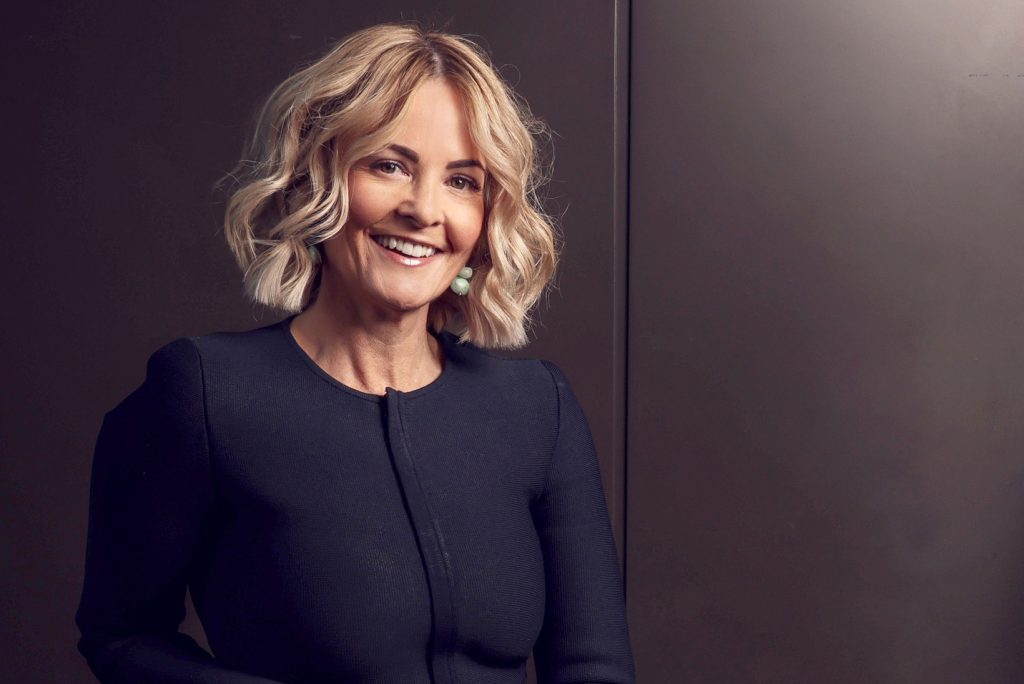
On reflection, six years on, the Lisa of today would naturally be more open in sharing personal challenges to the wider team.
“I’ve had a few friends who have had similar scares and my first advice was to be open with people because the trust and support you receive in return is actually amazing,” Lisa recommended.
“Everyone wants to help you and in my case, it brought my team much closer together and closer to me. There was instant respect without the need for anyone to earn it.”
What started as an annus horribilis transformed into a year to remember.
George came out of the other side and is now celebrating six years cancer free while the business reached record-breaking revenue with numbers smashed across the board.
“My husband is my grounder, I would work 25 hours a day if there were 25 hours in a day,” Lisa said. “But he’s the one that is advocating balance and to carve out family time which is so important.
“And my team were great. Many of those individuals are still with the business today – they were so hungry and helped me look good in the business. We were the tightest team.”
Raised in Titirangi – a suburb of West Auckland in the Waitākere Ranges – Lisa was destined for a career in sales from a young age, with a notable aspiration to be on the trading floor.
The appeal is unsurprising given the psyche of this young Kiwi.
There’s an almost cinematic quality to the trading floor – the whistle blows and the battle begins. Markets open and adrenaline spikes. Traders lean forward, scanning movements by the second, hunting opportunity, reacting to threats. Deals are struck in rapid-fire exchanges. Margins are thin, egos often thinner. Performance is public, measured and immediate.
The stereotype paints it as cut-throat – survival of the fastest, the boldest, the most aggressive.
“That’s it, total chaos for a set period and then it’s all over,” outlined Lisa, with a smile.
“I think that’s what I’ve always loved about sales – the energy that you get when you win something. I never made it to the trading floor but I did work for Citibank for a while as a project coordinator.”
The big OE (overseas experience) arrived in London for 18 months, followed by Melbourne, back to London and then to Boston before returning to settle in Melbourne.
While overseas, Lisa – who trained as a ballerina for 17 years growing up in New Zealand – took elocution lessons. This was early 2000s, a time when local accents hadn’t quite infiltrated the boardrooms of the corporate world.
“When I was in London, I really thought my accent was horrific,” Lisa said.
“I didn’t want to sound like that anymore and nobody could understand me so I took lessons and learned how to say, ‘how now brown cow’. Being a ballerina helped because that taught me discipline and the acting and performing element that goes with it.
“When I worked in the US, I spoke like an American. I’ve never told many people this but I’m very good at mimicking people.”
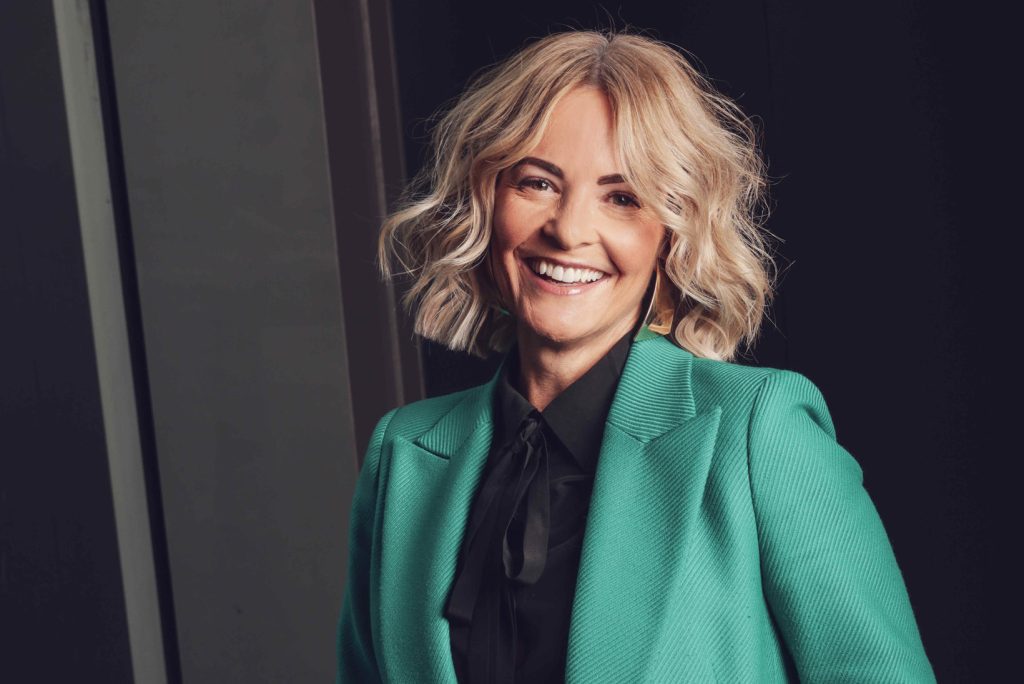
Despite being well-travelled, Lisa is a New Zealander at heart and always goes for the All Blacks.
“Of course. Why support Australia and put myself through misery?” Lisa laughed.
“We’re a big rugby family and I remember being at the 2003 Rugby World Cup in Sydney with my husband’s mates who thought I was just pretending to like rugby. Then I rattled off the 1987 Rugby World Cup winning All Blacks’ team one by one.
“You know, Australia has not won the Bledisloe Cup since I met my husband so I’m very much viewed as the jinx in our house – the night that eventually does happen I’ll be turning my phone off because my family will just rip into me.”
But there’s more to it than patriotism.
Research by Harvard-affiliated academics indicates that the All Blacks’ sustained success is rooted in a unique, deliberate culture rather than just talent. In other words, “better people make better All Blacks”.
Key practices include “sweeping the sheds” for humility, distributing leadership among players and relentlessly pursuing marginal gains, all aimed at maintaining high performance and avoiding complacency.
“There’s a piece in Richie McCaw’s book about the changing sheds,” Lisa described.
“And how before a Bledisloe Cup match, the maintenance guy came into the changing shed for the Wallabies and there was rubbish everywhere. All the players had left and nothing had been cleaned up.
“Compared to the All Blacks – Dan Carter was picking up rubbish and the entire team left the room as they found it. It doesn’t matter if you’re the best player or the captain, you’re part of a team.”
The “no dickheads” policy created by Gilbert Enoka – a performance coach for the All Blacks – was born out of a need to fix a toxic culture.
“It’s part of being a New Zealander – you have to keep pushing hard so that people actually notice you but you can’t get ahead of yourself,” Lisa summarised.
After assuming the role of Victoria Sales Manager in early 2020, Lisa progressed to National Sales Manager and then National Sales Director – leading a large team of sellers, pre-sales engineers, vendor partner managers, sales operations, bid management and customer success managers.
In January 2025, she was tasked with leading the local business as General Manager of Australia.
“Looking back, it’s been a big year, a head down kind of year,” Lisa noted. “We now have an established leadership team in place and have made all of the transformation changes required to ensure the business is successful in the year ahead.”

Day one as a new country leader is quieter than you expect. There’s no dramatic soundtrack or ceremonial handover that captures the weight of it.
But every decision does have a wider shadow. The emails feel heavier. The conversations carry more consequence. Even small choices ripple further than they did yesterday.
“I never felt the need to change because I’d been in the business for 10 or 11 years so everyone knows the ‘warts and all’ of Lisa Fortey,” Lisa accepted. “My biggest issue was the self doubt because we’re paying salaries and we’re dealing with people’s lives.”
According to Lisa, one area that the business lacked in previous years was consistency and communication.
“We talked about EBITDA but only as a metric to our business – no one really understood what that meant in terms of how to contribute or influence that number as an individual or team,” Lisa expanded.
In that same vein, renewed focus on self-development has resulted in the creation of Logicalis Libraries – a collection of self-development books housed in each company office across Australia. This is in addition to Logicalis in the Loop, a monthly newsletter providing key business updates and quarterly town halls.
“I’m very transparent on where we are with the numbers but equally, how every single person in the business – whether you’re an engineer, seller, receptionist, support staff or marketer – can contribute to EBITDA,” Lisa continued.
“We’ve been consistent in that messaging and if you can get the right message across and you’re consistent in how you deliver it, then the trust within the team just builds. And that builds energy in the business which we’re starting to see show up in our employee value proposition and performance goals.”
During one town hall, Lisa made a “very controversial statement” to the entire company – ‘every single person in our business is a sales person’.
“The first responses were ‘no, I’m not a salesperson’ but actually, we all are,” Lisa clarified.
“The first sales interaction for anyone who comes through our front door is when our receptionist greets them – that’s the first part of the journey with Logicalis and we’ve embedded that into our culture.”
During COVID-19, Lisa took part in the Logicalis Leaders Academy, a four-year program focused on executive development. One exercise was designed to understand how quickly leaders jump to conclusions.
“I was ready to execute everybody,” Lisa revealed.
“There was no right or wrong but the aim was to undercover how quickly you made a decision without all of the information. So, they kept feeding you information and one of the main takeaways that I learned was the power of asking different people different things.
“But at the same time, you can’t let everyone’s opinion cloud your judgement. We had struggled to make decisive decisions in the past which was another key area that I wanted to change.
“We could embrace a ‘fail fast’ mentality which is great but the biggest issue in making a business successful is indecision. Being an indecisive leader can be very damaging so I’m going to make a decision, even if it might not always be the right one.”
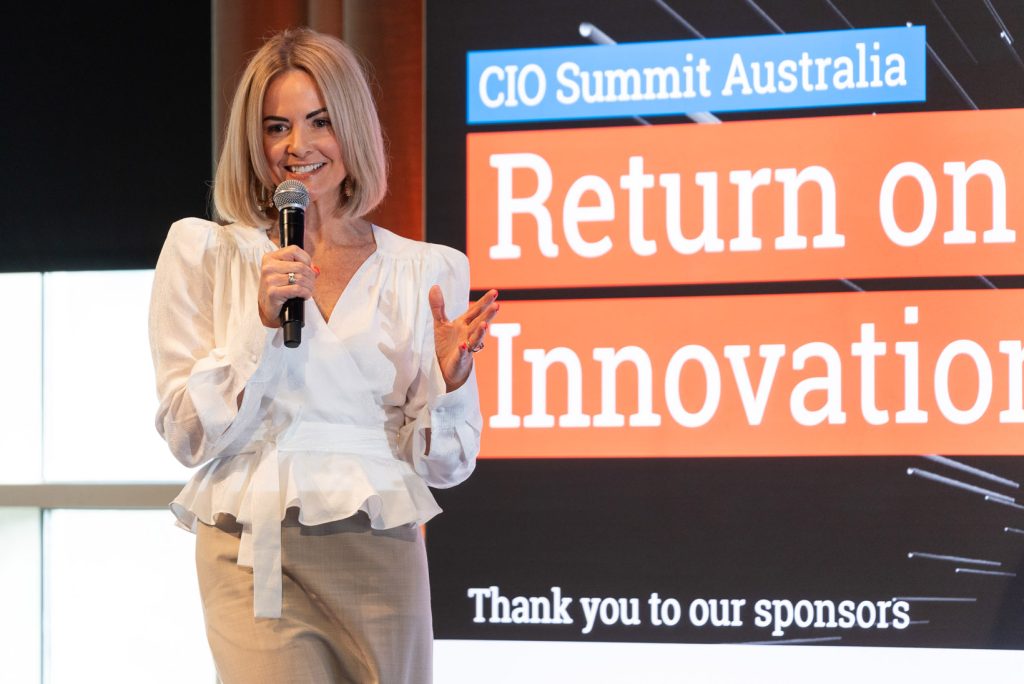
In many ways, presenting is a form of leadership in miniature.
You are asking people to follow your thinking for a set period of time. If you can’t decide what you stand for in those moments, neither will they.
Being decisive as a presenter is less about speed and more about clarity.
You know your argument. You understand your data. You’ve chosen your angle deliberately. That confidence translates into calm authority.
“Our CEO, Bob Bailkoski, is a phenomenal presenter,” Lisa said. “He presented at our CIO Summit a few years ago and was on stage for 30 minutes with no notes – completely charismatic and engaging.
“I said to him afterwards, ‘I hope you don’t think that I’m pissing in your pocket but I really want to understand, how can you stand up there and deliver that flawlessly without any ums or buts?’ He responded, ‘I practice in front of the mirror. I make time to practice’.”
Up until that point, Lisa was such the perfectionist that every word would be scripted – written down in the event of a memory blank. But it often came across as stilted and unnatural.
“Bob is a really good human being and very authentic in his leadership style,” Lisa added. “That was very generous of him to answer honestly even though he has such a big global CEO role, he could have just said it came naturally and I would have believed him.
“It was one of the best pieces of leadership advice that I’ve received because I do practice more and now people come up to me and comment that I present more confidently. It’s something I now love instead of hate.”
As Lisa has proved, self-competition is a powerful force. The key lies in calibration, however.
Healthy self-competition drives progress; unhealthy self-competition denies perspective. One builds momentum; the other builds pressure. In a career, the goal is not to silence the inner competitor, but to ensure it pushes you forward without pulling you apart.
“My one piece of advice?” Lisa concluded.
“Never say no to anything. Always say yes. You’ll never be ready for a role but you’ll never regret taking it. I’ve long had a mantra of never having any regrets but I do regret not taking a leadership role sooner.”
Inform your opinion with executive guidance, in-depth analysis and business commentary.

